Why the 2026 Chevrolet Equinox EV Makes the Tesla Model Y Look Overpriced
The 2026 Chevrolet Equinox EV delivers up to 319 miles of range for under $35,000, undercutting rivals like the Tesla Model Y while offering impressive practicality, comfort, and real-world usability.
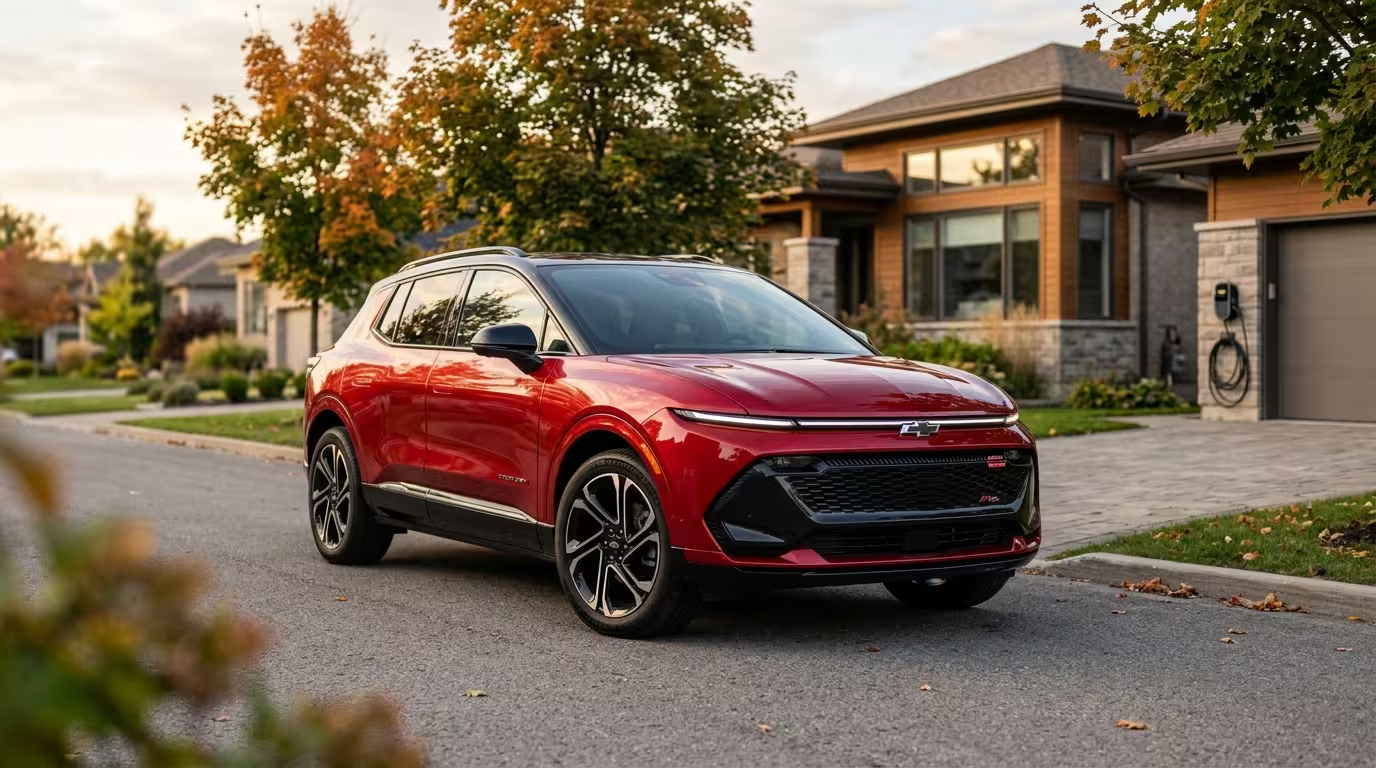
If you care about squeezing every mile out of a dollar, stop scrolling. The 2026 Chevrolet Equinox EV isn’t flashy. It doesn’t do 0-60 in a blink or wrap you in stitched leather and open-pore wood. But it does something far more important for the family trying to go electric without draining the college fund: it delivers 319 miles of EPA-rated range for a starting price of $34,995. That’s not a teaser rate. That’s a fully drivable, long-range electric SUV that happens to undercut the Tesla Model Y by several thousand bucks, outrange a base Mustang Mach-E by a comfortable margin, and still leave room in the budget for a Level 2 home charger.
We’ve spent enough time crunching window stickers, charging curves, and independent instrumented tests to know the Equinox EV isn’t perfect. But what it gets right matters more than any quibble about hard plastics or a missing smartphone projection feature. This is the kind of vehicle that quietly reshapes a segment. And we think it deserves a close, unflinching look.
Quick Facts – 2026 Equinox EV At A Glance
- Starting MSRP: $34,995 (LT1 FWD), plus $1,800 destination
- EPA-estimated range: 319 miles (FWD) / 285–307 miles (AWD)
- Horsepower: 220 hp (FWD) / 300 hp (AWD)
- Torque: 243 lb-ft (FWD) / 355 lb-ft (AWD)
- DC fast charging: Up to 150 kW, 10–80% in roughly 35–40 minutes
- Level 2 home charging: 11.5 kW onboard charger, about 30–36 miles of range per hour
- Battery warranty: 8 years / 100,000 miles
- Cargo volume: 26.4 cu ft behind rear seats / 57.2 cu ft with seats folded
- Passenger volume: 102.24 cu ft
- NHTSA overall safety rating: 5 stars
The Affordable EV That Doesn’t Cut Corners
The early EV era was dominated by six-figure showpieces. Those cars proved a point, but they never asked what a working family with two kids, a mortgage, and a 50-mile daily commute actually needs. The 2026 Equinox EV answers that question with a combination of usable range, tight packaging, and a purchase price that doesn’t induce heart palpitations.
Chevy’s play here is remarkably simple. Take the Ultium battery architecture shared with everything from the Hummer EV to the Cadillac Lyriq, shrink it into a compact SUV footprint, and price it against well-equipped gas crossovers. The result is a vehicle that asks a genuinely disruptive question: if you can get 319 miles for $34,995, why would you pay more for a Tesla badge? The Tesla Model Y remains the best-selling EV in America, but its price tag now sits firmly above $40,000. Meanwhile, the Equinox EV FWD covers more ground on a single charge than a base Model Y.
That doesn’t mean the Chevy is the right choice for everyone. But it does mean the old excuses for avoiding an EV are crumbling. Even in the luxury space, a vehicle like the Lucid Gravity proves what is technically possible, but the Equinox EV brings the concept down to earth. This is the EV you actually buy.
2026 Equinox EV Pricing and Trims
Chevrolet keeps the lineup mercifully simple. Three trims: LT1, LT2, and RS. All-wheel drive is available across the board as a $3,300 upcharge, and the destination fee is a non-negotiable $1,800. The base LT1 FWD starts at $34,995 before that fee. A fully loaded RS AWD can climb past $54,000, but most well-configured examples will land in the low-to-mid $40,000 range.
| Trim | Drivetrain | MSRP (incl. destination) |
|---|---|---|
| LT1 | FWD | $36,795 |
| LT1 | AWD | ~$38,000 (est.) |
| LT2 | FWD | $43,595 |
| LT2 | AWD | ~$45,000 (est.) |
| RS | FWD | $45,895 |
| RS | AWD | ~$47,000+ |
It’s worth noting the Ultium platform’s reach. The Honda Prologue shares this architecture and recently got its own Price Cut Update to stay competitive. But between the two, the Equinox EV still holds the edge in maximum range and base price accessibility.
Range and Battery
The numbers are real. 319 miles EPA combined for the front-wheel-drive version. Go AWD and you’re looking at 285 to 307 miles, depending on wheel and tire spec. That’s not just a lab figure that evaporates at 70 mph. Independent testing from Recharged and other outlets shows the Equinox EV delivering close to its EPA estimates in mixed driving. In other words, Chevy’s range claims are more honest than some, and that trustworthiness matters when you’re planning a road trip with a restless toddler in the back.
The battery is an 85 kWh gross Ultium pack using NCMA cathode chemistry and a blended graphite anode. It’s an in-house design, not something pulled off a supplier’s shelf. GM covers it with an 8-year/100,000-mile warranty, which should soothe the anxiety of long-term buyers. In daily use, the car’s efficiency and steady power delivery make it easy to hypermile if you’re so inclined, though we suspect most owners will just drive normally and still see excellent real-world range.
For families with larger seat-count needs, the upcoming Hyundai Ioniq 9 offers a three-row alternative with its own impressive range figures, but the Equinox EV remains the more affordable entry point for five-passenger households.
DC Fast Charging and Home Charging Explained
Here’s where the Equinox EV is competitive, not class-leading. Peak DC fast-charging rate is 150 kW. On paper, Chevrolet claims roughly 77 miles of range replenished in 10 minutes. Independent testing paints a slightly more nuanced picture: the car hits that peak rate briefly at low state-of-charge, then tapers. A 10–80% session typically takes 35–40 minutes, and a full 10–90% charge stretches past 50 minutes. That’s fine for a bathroom-and-coffee stop, but it’s not the neck-snapping pace of a Hyundai Ioniq 5’s 800-volt architecture.
At home, the 11.5 kW onboard charger adds 30–36 miles of range per hour on a 240-volt circuit. Overnight top-ups will be the norm, and most owners will wake up to a full “tank.” One annoyance: the 2026 model year still uses a CCS1 charge port. A native NACS (Tesla-style) port is coming for 2027. Current owners can use a GM-approved adapter at Tesla Superchargers, but the cleaner solution is still a year away. If you road-trip frequently, that may nudge you toward waiting or toward a competitor that already has integrated NACS.
On the plus side, the real cost of driving an EV can be startlingly low compared to gasoline. Run your own scenario through our Fuel Cost & Savings Calculator to see how the Equinox EV stacks up against your current crossover.
Performance
You don’t buy this car for the 0-60 time. The front-drive model makes 220 hp and 243 lb-ft of torque, and it ticks off the 0-60 sprint in about 7.5 seconds. That’s entirely adequate for highway merges and suburban errands, but it won’t pin you to your seat. It feels exactly as quick as it needs to be, and not one bit more.
The dual-motor AWD version is a different animal. With 300 hp and 355 lb-ft, it cuts the 0-60 run to somewhere between 5.7 and 5.9 seconds. The sensation isn’t dramatic, just a relaxed, confident shove that makes passing on two-lane roads a non-event. More importantly, AWD brings a level of traction and poise that makes wet or snowy commutes feel drama-free.
The chassis tuning prioritizes ride comfort over handling sharpness. It soaks up expansion joints and broken pavement with an almost Buick-like isolation. The steering is light, accurate, and entirely devoid of feedback. You won’t find yourself taking the long way home for the joy of it, but you will arrive relaxed. That’s the tradeoff. Towing is capped at a modest 1,500 lbs, so think kayak trailer or bike rack, not a boat.
Interior and Technology
Climb inside and the focal point is the 17.7-inch diagonal touchscreen, paired with an 11-inch digital gauge cluster. The Google Built-In system is snappy, logically organized, and genuinely easy to live with. Voice commands through Google Assistant work well, and the navigation predicts battery state along a route with refreshing accuracy.
But Chevy made a decision that has real consequences: there is no Apple CarPlay or Android Auto. Not as a hidden setting, not as a dealer-installed option. Nothing. The company bet that Google’s ecosystem is good enough to stand alone. For some drivers, that bet will pay off. For anyone deeply integrated into Apple’s world, it’s a sharp irritant that will resurface every single day.
Available Super Cruise hands-free driving on LT2 and RS trims is a genuinely useful addition. It operates on hundreds of thousands of miles of pre-mapped highways and adds a level of long-haul serenity that’s rare at this price. If you’re a road-tripper, it’s worth the option cost.
Cargo and Passenger Space
The Equinox EV swallows 26.4 cubic feet of cargo behind the rear seats and 57.2 cubic feet with the 60/40 bench folded. Those figures are competitive with the Ioniq 5 and Mach-E, though the Tesla Model Y edges ahead slightly in sheer cargo volume. The load floor sits low and flat, which makes sliding in a stroller or a Costco haul refreshingly painless.
Passenger volume comes in at 102.24 cubic feet, and the cabin makes excellent use of it. Headroom and legroom are generous front and rear, and the flat floor in the second row means the middle seat isn’t a punishment. Four six-foot adults can cover long distances without complaint. For families who need a third row, the Kia EV9 offers that capability in a larger, pricier package. But if five seats are enough, the Equinox EV feels spacious without feeling oversized.
Safety
The NHTSA gave the 2026 Equinox EV a 5-star overall safety rating, and that score applies to both FWD and AWD. Every trim includes Chevy Safety Assist, which packs automatic emergency braking, front pedestrian braking, lane keep assist, forward collision alert, IntelliBeam auto high beams, and a following distance indicator. The base car doesn’t make you pay extra for the fundamentals, and that’s a rare and welcome strategy.
Higher trims can unlock the Active Safety Package 3, which adds Super Cruise and Enhanced Automatic Parking Assist. Even without it, the Equinox EV feels like a car designed by people who understand that safety shouldn’t be a luxury add-on.
Equinox EV vs. The Competition
| Model | Starting Price (approx.) | EPA Range (base) | Horsepower | Cargo (rear seats) |
|---|---|---|---|---|
| 2026 Chevy Equinox EV | $34,995 | 319 miles | 220 hp | 26.4 cu ft |
| Tesla Model Y | >$40,000 | ~295 miles | ~295 hp | 30.2 cu ft |
| Hyundai Ioniq 5 | ~$42,000 | 245–318 miles | 168 hp (base) | 27.2 cu ft |
| Ford Mustang Mach-E | ~$40,000 | ~250 miles | 266 hp (base) | 29.7 cu ft |
The Tesla Model X lives in a different universe entirely, with a price tag that could buy two well-equipped Equinox EVs. For the family that wants electric capability without the premium-brand surcharge, the choice is increasingly clear.
Pros and Cons
What we like
- Segment-leading value: 319 miles of range for under $35,000 is simply unbeatable
- Quiet, absorbent ride that makes daily commutes less tiring
- Google Built-In interface is responsive and logical, even if the ecosystem tradeoff stings
- Super Cruise availability is a genuine differentiator at this price point
- Solid safety credentials with 5-star NHTSA rating and comprehensive standard assists
What gives us pause
- FWD acceleration is utilitarian, not fun; the AWD upgrade is almost a must for driver satisfaction
- The absence of Apple CarPlay and Android Auto will alienate a measurable slice of shoppers
- Hard plastics on lower door panels and dash corners betray the price point in LT trims
- Driving dynamics favor isolation over engagement; enthusiasts should look to the Mach-E or Ioniq 5
- CCS1 charge port means an adapter is required for Supercharger access until the 2027 refresh
2026 Equinox EV Sales
Cox Automotive reported 9,589 Equinox EVs sold in the U.S. during Q1 2026. That made it the fifth best-selling EV in the country, slotting behind the Tesla Model Y, Model 3, Toyota bZ4X, and Hyundai Ioniq 5. A slight dip from the prior year doesn’t change the bigger story: the Equinox EV is now the top-selling electric vehicle in GM’s lineup, and it’s drawing buyers who never considered a Chevy EV before. Value, it seems, still sells.
Who Should Buy the 2026 Equinox EV?
This car makes a brutally practical case for itself. Yes, if you want the most range for the least money and a quiet, spacious cabin that does the daily grind without complaint. Yes, if you can accept Google Built-In as your sole infotainment ecosystem and value range over 0-60 bragging rights.
Who Should Skip the 2026 Equinox EV?
Skip it if losing Apple CarPlay feels like a step backward, if you crave a genuinely fun driving experience, or if you want the convenience of an integrated NACS charge port without adapters.
For the vast middle of the market, the 2026 Chevrolet Equinox EV is the electric crossover that makes sense right now. No asterisks.
Test drive a 2026 Chevrolet Equinox EV at your local dealer and feel the value proposition in person. Before you go, use our Car Loan Calculator to estimate monthly payments and our Fuel Cost & Savings Calculator to see your potential savings versus a gasoline crossover.
Disclaimer: Information based on data available as of May 2026. Specifications and pricing subject to change. Always verify with your local dealer before purchase.Sources & Citations
Primary public references used for U.S. vehicle research on AutoTechSpot: