2026 Tesla Model Y Price Cut: What Buyers Should Know
The 2026 Tesla Model Y price cut changes the EV value math. See what dropped, what stays optional, and whether shoppers should buy now or wait.
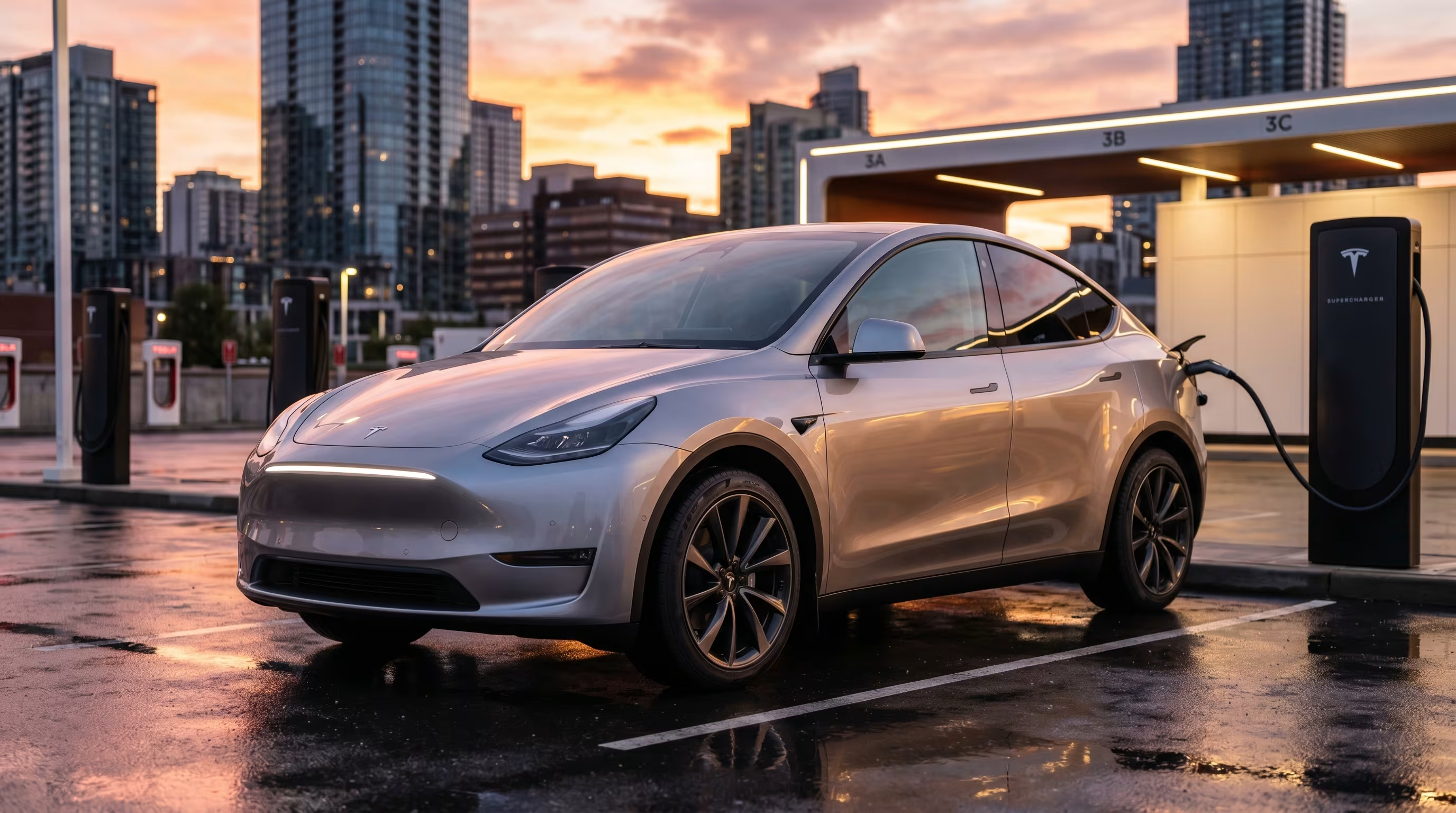
A quiet configurator update. An $11,000 price drop. Zero fanfare. On April 4, 2026, Tesla slipped a new Long Range All‑Wheel Drive variant of the revamped Model Y onto its U.S. order page, and the starting number $48,990 changes the entire mid‑size electric crossover conversation.
The Launch Series that dominated the Juniper rollout since late 2025 is gone from the ordering screen. In its place sits a mechanically identical vehicle that simply unbundles the $8,000 Full Self‑Driving package. Same car. Same ventilated seats, same revised suspension, same 327‑mile range. Just without the mandatory software surcharge that locked thousands of potential buyers out of the transaction.
For anyone watching Tesla’s delivery numbers and stock trajectory this year, the move feels less like a generous gift and more like a company clearing its throat before asking for help. We’re going to dissect what $48,990 actually buys you, why the price cut happened now, and whether this is the Model Y you should buy or a signal that the broader EV market is taking a turn nobody wanted to admit.
Quick Facts: 2026 Model Y Pricing at a Glance
| Spec | New Long Range AWD | Launch Series |
|---|---|---|
| Base MSRP | $48,990 | $59,990 |
| Savings | N/A | $11,000 less |
| Range (EPA) | 327 miles | 327 miles |
| 0–60 mph | 4.6 sec | 4.6 sec |
| Top Speed | 125 mph | 125 mph |
| Full Self‑Driving | Optional ($8,000) | Included |
| Federal Tax Credit | Up to $7,500 (see disclaimer) | Same |
| Effective Price After Credit | As low as $41,490 | As low as $52,490 |
Why Tesla Pulled the Pricing Lever
The Launch Series was a clever launch strategy bundle the expensive software, dress it up with exclusive badging, and set the price at $59,990 to anchor the Juniper refresh as a premium product. But it had a shelf life. Once early adopters were satisfied, that bundling became a barrier for the typical family buyer who just wants a comfortable EV with great range and access to the Supercharger network.
Tesla clearly knows this. The new $48,990 Long Range AWD removes FSD from the mandatory column and instantly reopens the Model Y to a far larger audience. But the timing tells a parallel story that has less to do with product strategy and more to do with cold quarterly math.
The company delivered 358,023 vehicles globally in Q1 2026 about 7,600 units below Wall Street expectations. The more uncomfortable number: Tesla built roughly 53,000 more Model 3 and Model Y units than it sold during those three months, stuffing inventory to record levels. When you’re producing 50,000 more cars than you can move, aggressive pricing becomes the fastest lever to yank. And Tesla’s stock, already down more than 20% on the year by early April, didn’t have much tolerance for creative solutions that take months to yield results. The configurator update happened fast.
What we’re seeing is not panic, but it’s also not confidence. It’s a pragmatic, margin‑compressing response to a market that no longer treats Tesla like the only game in town.
What the $48,990 Model Y Actually Delivers
Strip away the pricing noise and this is the same Juniper‑refresh Model Y that earned strong reviews for its ride quality and cabin upgrades. The dual‑motor all‑wheel‑drive system puts out 346 hp and 376 lb‑ft of torque, pushing the crossover to 60 mph in 4.6 seconds. Real‑world range hovers around 300‑320 miles depending on speed and temperature exactly where you’d want a family EV to sit for road trips and daily shuttling alike.
The hardware improvements over the pre‑2026 car are substantial. Ventilated front seats finally solve the swampy‑back problem that plagued earlier Model Y’s in summer. An 8‑inch rear screen keeps kids occupied without an iPad dangling from the headrest. The 256‑color ambient lighting sounds gimmicky until you drive at night and realize how much it softens the cabin. And the suspension rework softer over broken pavement, more composed in corners addresses the single biggest criticism of the old Model Y.
None of that goes away with the price cut. The only thing you lose is the bundled FSD license, and frankly, that’s a good thing for most buyers.
Key Specs, Unchanged
| Specification | Value |
|---|---|
| Battery | ~82 kWh (improved energy density) |
| EPA range | 327 miles |
| Drivetrain | Dual‑motor AWD |
| Power / Torque | 346 hp / 376 lb‑ft |
| 0–60 mph | 4.6 seconds |
| Top speed | 125 mph |
| Cargo capacity | 33.1 cu ft (rear seats up) |
The Software Monetization Shift Nobody’s Talking About
Here’s where the analysis has to go deeper than the sticker price. Tesla’s decision to unbundle FSD from the base Model Y isn’t just about lowering the entry point it’s a structural pivot in how the company thinks about monetizing its vehicles. For years, Wall Street has been sold a vision where software revenue would prop up margins as hardware costs came down. Mandatory FSD on the Launch Series was a test: could Tesla force adoption and collect high‑margin software dollars at the time of sale?
The test apparently didn’t scale. By decoupling FSD and chopping $11,000 off the price, Tesla is acknowledging that upfront software bundling alienates too many buyers. The new strategy is to get metal on the road first, build a bigger fleet, and then sell or subscribe to FSD later when the technology is actually good enough to convince people organically. It’s a long‑term play dressed as a short‑term discount.
This matters because it signals that Tesla’s software revenue ambitions are being reined in by real‑world consumer behavior. People will pay for a great electric car. They’re much less willing to pay eight thousand dollars upfront for a set of features that still require driver supervision and face regulatory headwinds. If the market is telling Tesla that, then other automakers should pay attention too.
Federal Tax Credit
As of May 2026, the IRS still lists the Model Y Long Range AWD as eligible for the full $7,500 federal tax credit. That slashes the effective price to $41,490 for buyers who qualify under the income caps ($150,000 single, $300,000 joint). Tesla’s own IRA page, however, still displays a confusing “Ends September 30, 2025” banner that hasn’t been updated. The credit delivery mechanism point‑of‑sale rebate or tax return is straightforward enough, but battery sourcing rules can shift, and any change in administration policy could alter eligibility with little warning. Check the fueleconomy.gov list the day you order and talk to a tax professional who understands EV credits, not just any CPA.
Stacking Up Against the Competition
The Model Y’s $48,990 sticker sits above the base trims of the Hyundai Ioniq 5 and Ford Mustang Mach‑E, but the comparison isn’t as simple as a lowest‑price‑wins contest.
| Feature | Tesla Model Y Long Range AWD | Hyundai Ioniq 5 SE RWD Standard Range | Ford Mustang Mach‑E Select RWD |
|---|---|---|---|
| Base MSRP | $48,990 | $35,000 | $37,795 |
| Effective Price (with credit) | $41,490 | $35,000 (credit may vary) | $37,795 (partial/no credit) |
| EPA Range | 327 miles | ~240 miles | 260 miles |
| Drivetrain | Dual‑motor AWD | Single‑motor RWD | Single‑motor RWD |
| 0‑60 mph | 4.6 sec | ~7.4 sec | ~5.8 sec |
| Cargo Capacity | 33.1 cu ft | 27.8 cu ft | 29.7 cu ft |
| Charging Network | 17,000+ Superchargers | CCS (limited 350 kW) | CCS / BlueOval |
What Tesla still does better than anyone is charge anxiety. The Supercharger network, now partially open to other brands, remains the most integrated and reliable fast‑charging ecosystem in North America. For families who road‑trip, that matters. For those who want a larger electric SUV with three rows, we’ve tracked the Kia EV9 closely and the Hyundai Ioniq 9 promises even more interior flexibility but those sit in a different price and size class entirely.
So Where’s the Cheaper Rear‑Wheel‑Drive Model?
Not on the U.S. order page yet. Canada and other markets have been selling a RWD Model Y with roughly 290 miles of range since early 2026. Tesla will almost certainly bring that configuration stateside later this year, likely priced in the high $30,000 range. When it does, the Model Y becomes a direct pricing rival to those base Ioniq 5 and Mach‑E trims, but with the Supercharger network and Tesla’s over‑the‑air update infrastructure baked in. If you don’t need AWD and can wait a few months, patience might save you another chunk of change.
Is FSD Worth $8,000? For Most, Probably Not.
We’re not here to dunk on Full Self‑Driving it has improved substantially, and the highway experience is genuinely less fatiguing with it active. But for the typical buyer using this car for commuting, grocery runs, and the occasional weekend trip, standard Autopilot handles the heavy lifting. Adaptive cruise control with lane‑keep assist is included at no extra cost. FSD adds automated lane changes, off‑ramp navigation, and city‑street capability that’s still catching up to the promise. Unless you’re logging 15,000 highway miles a year and dread every merge, save the $8,000.
What This Says About EV Demand in 2026
Let’s zoom out. Across the industry, EV growth is continuing but the rate of growth is slowing. Early adopters have their cars. The next wave of buyers is more price‑sensitive, more concerned about charging logistics, and less willing to pay a premium for a powertrain type. Tesla’s price cut doesn’t happen in a vacuum. Hyundai slashed Ioniq 5 prices aggressively for 2026. Ford has been tweaking Mach‑E MSRPs and offering incentives. Chinese manufacturers, though locked out of the U.S., are proving that capable EVs can be built and sold profitably below $30,000.
The market is maturing. That’s good for consumers it means more choice and better value. For Tesla, it means the days of 30% margins and endless waiting lists are over. The $48,990 Model Y reflects that new reality. It’s priced to move metal, not to set records on the income statement.
Final Thought
This is the Model Y configuration most buyers have been waiting for since the Juniper refresh landed. You get the new suspension, the ventilated seats, the quieter cabin, and the Supercharger network all without subsidizing a software package you may never fully use. At $41,490 after the federal credit, it’s one of the strongest values in the entire electric crossover segment.
The main reasons to hesitate are practical, not existential. A rear‑wheel‑drive version may arrive later this year and drop the starting price further. The tax credit’s long‑term stability is never guaranteed. And if you’re comparison‑shopping, the Ioniq 5 and Mach‑E are better than they’ve ever been so test drive before you click “order.”
Check Tesla’s official configuration page for current delivery windows. And if you’re curious how the flagship Tesla stacks up, we’ve published a full 2026 Tesla Model X review that digs into where the brand is really heading.
Sources & Citations
Primary public references used for U.S. vehicle research on AutoTechSpot: