Hyundai Ioniq 5 Sales Jump 14% in 2026 Without the $7,500 Tax Credit
Most EVs tanked after the tax credit died. The Hyundai Ioniq 5 didn’t. Here’s the real story behind the 14% Q1 sales increase and what it means for your next car purchase.
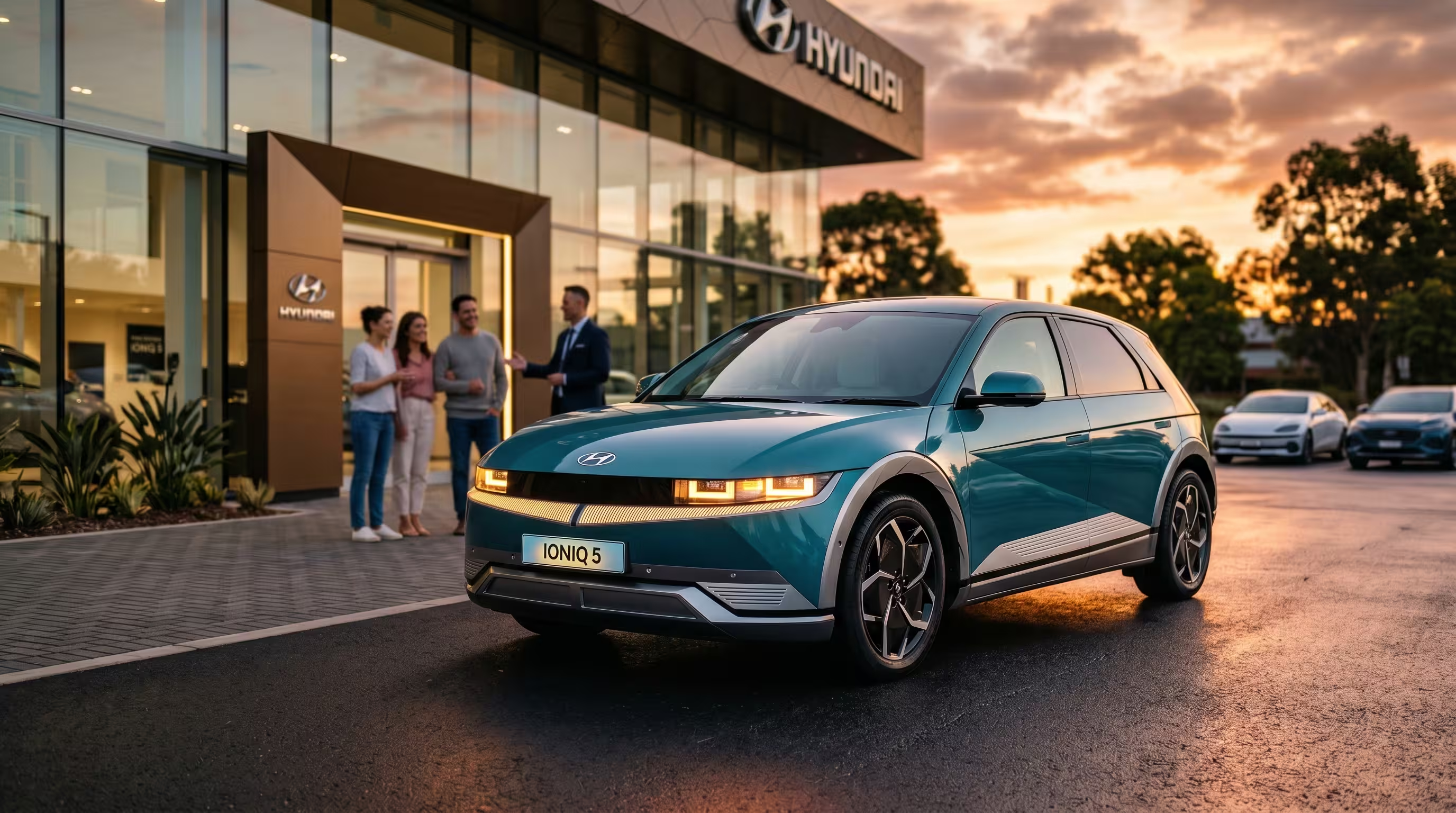
If you’d told me in October 2025 that a Hyundai EV would post double-digit sales growth six months after the federal tax credit vanished, I’d have asked what you were drinking. But the numbers don’t lie. In the first quarter of 2026, Hyundai sold 9,790 Ioniq 5 crossovers in the U.S., a +14% jump over Q1 2025. March alone accounted for 4,425 units, up +13% from a year earlier. The broader EV market, by contrast, fell an estimated 27%.
This isn’t a fluke. It’s a signal that the old rules no longer apply.
Why are Hyundai Ioniq 5 sales increasing in 2026?
Hyundai replaced the missing $7,500 federal tax credit with aggressive price cuts averaging $9,155. Shoppers keep choosing the Ioniq 5 for its 800-volt fast charging, crossover practicality, and decent inventory, proving a strong product can outlast a policy change.
Quick Facts: Ioniq 5 Q1 2026 Sales
Ioniq 5 Q1 2026 at a Glance
- Q1 U.S. sales: 9,790 units
- Year-over-year change: +14%< (vs. 8,611 in Q1 2025)
- March 2026 sales: 4,425 units (+13% YoY)
- Federal tax credit: Expired at end of September 2025
- Hyundai total Q1 U.S. sales: 205,388 units (+1%)
A Tale of Two Ioniqs: 5 Thrives, 6 Collapses
Look at the other side of the E-GMP platform and the story sharpens. The Ioniq 6 sedan sold just 829 units in Q1 2026, a startling –75% drop from 3,318 a year earlier. Two EVs sharing the same 800-volt architecture, the same parent company, and the same factory, but polar opposite results.
| Model | Q1 2026 Sales | Q1 2025 Sales | Year-over-Year Change |
|---|---|---|---|
| Hyundai Ioniq 5 | 9,790 | 8,611 | +14% |
| Hyundai Ioniq 6 | 829 | 3,318 | –75% |
How the Tax Credit Disappeared (And Why It Didn’t Matter for the Ioniq 5)
The $7,500 clean vehicle credit died on September 30, 2025, courtesy of the One Big Beautiful Bill Act. Not phased out. Terminated. Every Hyundai EV lost eligibility overnight. The rest of the industry felt the pain immediately, Audi’s EV sales plunged 89.6% in Q1 2026, Ford’s fell 70%, BMW’s dropped 63.3%.
Hyundai’s response was blunt. Instead of lobbying Congress, Randy Parker’s team took a knife to the window sticker. For the 2026 model year, Ioniq 5 MSRPs came down by $7,600 to $9,800 depending on trim, the average cut worked out to $9,155. Hyundai Motor North America CEO Randy Parker called it a “bold step” and a commitment to “exceptional technology and innovation without compromise.” I’d call it a $750-million-a-year lesson in market logic: you can replace a subsidy with a discount, but only if the product underneath is strong enough to convert interest into sales.
Why the Ioniq 5 Kept Winning
A lot went right, and it wasn’t just the price tag. Here’s what I’d point to as a market analyst.
Price Cuts That Outdid the Tax Credit
Hyundai didn’t wait for Washington. By lopping up to $9,800 off the top, the effective transaction price for a 2026 Ioniq 5 ended up lower than many subsidized 2025 models. Shoppers did the math: lower upfront cost, simpler paperwork, no income cap nonsense. The message landed.
Charging Speed and Real-World Range
The Ioniq 5’s 800V system can go from 10% to 80% in about 18 minutes on a 350 kW charger. That’s not a spec-sheet party trick; it’s the difference between a quick coffee stop and a half-hour wait. Combine that with over 300 miles of range on RWD trims, and you have an EV that doesn’t ask drivers to rebuild their lives around it.
Buyers Are Getting Smarter About EVs
The tax credit era pushed a lot of early adopters into EVs. The 2026 buyer is different. More people are comparing total cost of ownership, insurance, and charging convenience rather than hunting for the biggest government rebate. When a vehicle delivers tangible daily benefits, charging speed, interior space, a design that still turns heads, it doesn’t evaporate when a policy does.
You Can Actually Find One on a Dealer Lot
Remember the 2022 Ioniq 5 drought? Those days are over. Hyundai has sorted out allocation, and inventory is no longer a running joke. A great vehicle you can test-drive on a Saturday and take home on Monday will almost always outsell a theoretical one.
Hyundai’s Secret Weapon: A Hybrid Safety Net
Even as the Ioniq 5 carried the EV banner, Hyundai’s hybrid lineup quietly posted numbers that most automakers would kill for. The Santa Fe Hybrid jumped 47% in Q1 2026. The Elantra Hybrid shot up 141%, and the Sonata Hybrid climbed 107%.
This dual approach isn’t an accident. When a shopper isn’t ready for a full EV, range anxiety, apartment charging, whatever, Hyundai captures them with a hybrid instead of losing them to Toyota or Honda. Meanwhile, the Ioniq 5 grabs the early-majority EV buyer who no longer needs a tax credit as a reason to buy. It’s a strategy that could make Hyundai the most resilient player in the electrification game.
While Hyundai is navigating the post-credit shift with confidence, other corners of the electrified vehicle space are having a rougher time. Subaru recently recalled over 71,000 Forester and Crosstrek Hybrids over a fuel leak that requires owners to park outside. Read the details in
Subaru Recalls 71K Forester & Crosstrek Hybrids Over Fuel Leak
It’s a reminder that growing EV and hybrid volume isn’t always smooth.
The Long View: What the Ioniq 5’s Surge Says About the EV Market
This quarter tells us something uncomfortable but useful: the subsidy-dependent growth phase of the U.S. EV market is over. Automakers can no longer rely on a $7,500 line item on the window sticker to make their numbers work. The ones that survive the next two years will be those that build vehicles good enough to sell at their true price, or that permanently eat the credit themselves.
Hyundai proved it can do both. The $9,155 average price cut is a bet that volume will pay for itself, and so far, it has. The bigger question is whether Hyundai can hold this pricing without destroying margins once the Ioniq 9 arrives and production costs shift.
My guess: they’ll try to keep base prices aggressive through at least 2027, forcing rivals to respond. Honda already cut Prologue prices to stay competitive. We covered that move in Honda Prologue Price Cut Article.
The other lesson is about brand building. Every Ioniq 5 sold in 2026 is a rolling ad that screams “Hyundai took care of me when the tax credit disappeared.” That kind of loyalty has a long tail.
What Happens Next for Hyundai and the Ioniq 9
The Ioniq 5’s momentum sets the floor for the three-row Ioniq 9 coming later this year. If Hyundai prices the Ioniq 9 within 10-15% of the Ioniq 5’s top trims, I’d expect a similar adoption curve. The 9 offers more room and the same fast-charge architecture, and it will land in a market where the brand’s EV credibility is already established.
2026 Hyundai Ioniq 9 Review, its interior packaging alone could give Kia's EV9 a real headache.Should You Buy an Ioniq 5 Now?
If you’re on the fence, here’s the blunt version. The Ioniq 5, right now, is one of the few EVs that cost less than their 2025 equivalents despite losing the federal credit. You’re not waiting on a tax rebate that may never return. You’re getting a vehicle with proven reliability, fast charging, and a warranty that outruns most of its competitors.
The only con is supply. With sales running at this clip, popular trims don’t sit on lots for long. If you need three rows or the absolute latest tech, hold for the Ioniq 9. Otherwise, grab what’s available.
Check Hyundai dealer inventory near you, at these volumes, Ioniq 5s move fast. And if you’re curious about the bigger picture, read our full Ioniq 9 review to see where Hyundai’s EV strategy goes next.
Sources & Citations
Primary public references used for U.S. vehicle research on AutoTechSpot: