Ford Escape Discontinued After 2026, Final Model Year, 6-State Sales Ban & Alternatives
The 2026 Ford Escape is the nameplate’s final chapter, and it can’t be sold in six states. We break down the PHEV price cut, the CARB emissions ban, what replaces the Escape, and whether this last-call compact SUV is a smart buy or a trap.
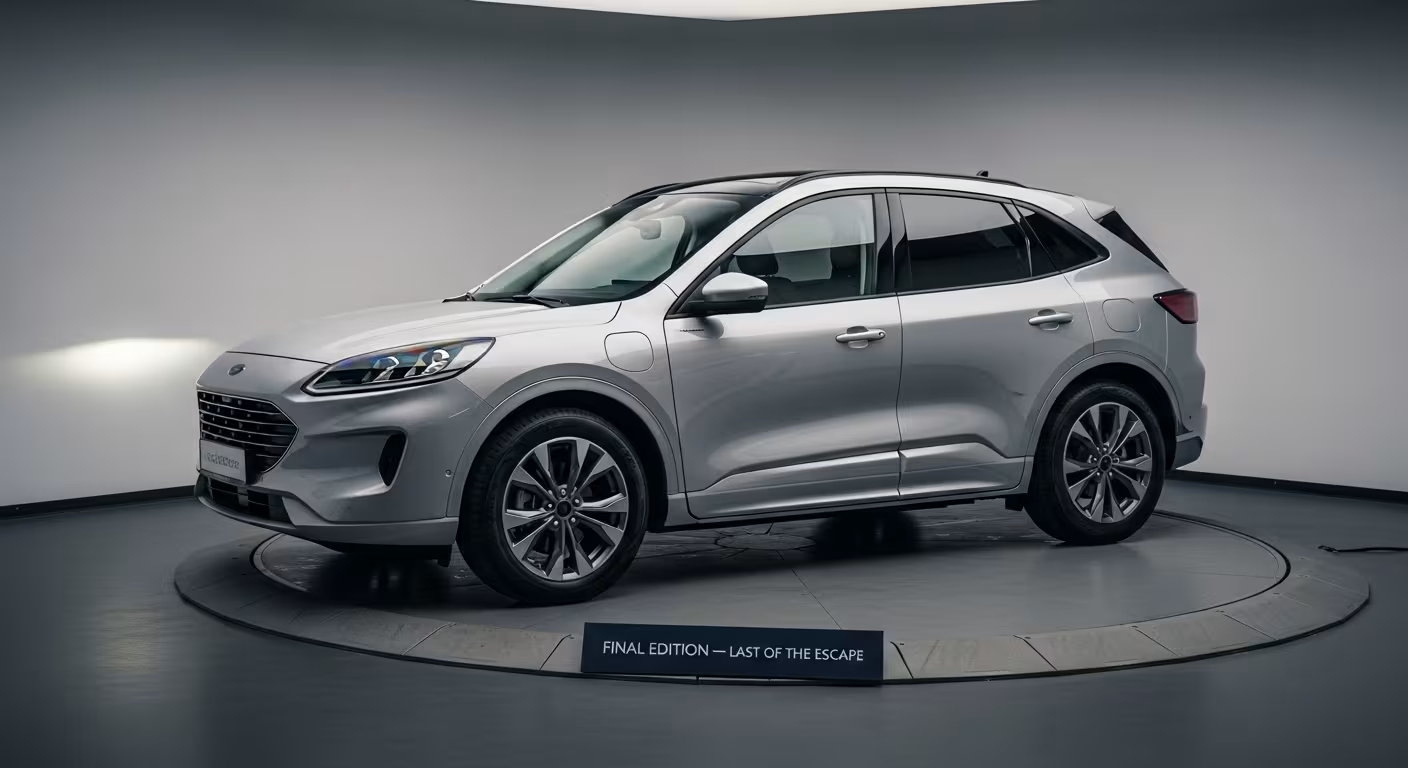
The End of an Era
The last Ford Escape quietly rolled off the line in Louisville on December 17, 2025. After 25 years and more than 5 million American sales, the nameplate’s final chapter is the 2026 model year, and it’s not a simple sunset. Ford has confirmed the Escape is done, and in a twist that few saw coming, the company won’t sell the 2026 model at all in six states that follow California’s emissions playbook.
That means if you live in California, New York, Massachusetts, Vermont, Oregon, or Washington, you can’t buy a new 2026 Escape, hybrid, plug-in, or otherwise. The decision strips away the final year of the Escape from roughly a third of the U.S. population, turning an already emotional farewell into a practical dilemma for compact SUV shoppers. Ford isn’t offering a direct successor, either. Instead, it’s betting that the Bronco Sport and the Maverick will absorb the buyers who used to walk in looking for a sensible two-row crossover.
We’ve dug into the factory bulletins, emissions filings, pricing sheets, and dealer communications to bring you the complete picture. This is everything you need to know about the final Ford Escape, whether you should buy one, and what it means for your next compact SUV purchase.
Quick Facts: 2026 Ford Escape at a Glance
- Final model year: 2026 (production ended December 17, 2025)
- States where the 2026 Escape cannot be sold: California, New York, Massachusetts, Vermont, Oregon, Washington
- Reason for the ban: Ford skipped CARB certification to contain costs on a dead model; all 2026 Escapes carry a federal-only emissions label
- Trim shuffle: Base ST-Line Hybrid discontinued; all hybrid Capable models now require all-wheel drive
- PHEV still available: Yes, but only in the 44 states where the 2026 Escape is legal
- Price paradox: PHEV drops $2,000 to $35,400; Platinum and ST-Line Elite climb $2,030
- What’s replacing the Escape: No direct one-for-one replacement; Bronco Sport and Maverick are Ford’s intended fill-ins
Why Is the Ford Escape Being Discontinued?
You don’t kill a nameplate that sold over 300,000 units a year at its peak without multiple forces at play. Two big ones converged here.
First, the factory
The Louisville Assembly Plant has been the Escape’s home since day one. Ford is spending $2 billion to retool that entire facility for a new generation of affordable electric vehicles built on a dedicated EV platform. The Escape and its Lincoln Corsair sibling don’t fit into that future, and the hard production math said the line had to stop. Ford’s head of media relations, Mark Truby, put it bluntly:
“Production will stop for Escape and Corsair later this year when we start retooling the plant.”
Second, the business case
The Escape’s U.S. sales settled around 140,000-147,000 units from 2022 through 2024, respectable, but a shadow of the nameplate’s late-2010s glory. In the same years, the Toyota RAV4 sold over 400,000 units annually, and the Honda CR-V routinely cleared 350,000. Even the Chevrolet Equinox outsold the Escape. Meanwhile, Ford was discovering that the Bronco Sport, which shares a platform with the Escape, commanded higher transaction prices and healthier margins, while the Maverick hybrid pulled in budget-conscious customers at an even lower price point. The Escape had simply become the middle child that the business didn’t need.
There’s a broader industry trend here, too. Automakers are streamlining lineups, killing off traditional sedans and conservative crossovers in favor of higher-profit trucks, off-road-flavored SUVs, and EVs. The Escape’s exit is not an isolated incident, it’s the Blue Oval following the money.
Which States Can’t Buy the 2026 Ford Escape? (And Why It Matters)
Six states block the 2026 Escape entirely. They are: California, New York, Massachusetts, Vermont, Oregon, and Washington. All have adopted California’s CARB emissions standards, and for 2026, those rules tightened in a way that required additional certification Ford elected not to pursue.
A Ford spokesperson acknowledged the decision, stating the vehicle “meets emissions requirements in all states except six states that for the 26MY imposed additional emission requirements.” In plain English, the Escape is clean enough for federal rules but not for the latest CARB hurdle. Rather than invest in certification for a model it was killing, Ford chose to walk away from those markets a year early.
The punchline: every single 2026 Escape, gas, hybrid, and plug-in hybrid, is affected. The PHEV is not a loophole. If you live in Los Angeles or Portland and want a new Escape, you’re looking at leftover 2025 inventory. Those 2025 models were 50-state compliant and are now the final link to the nameplate in CARB states. They’re disappearing fast.
2026 Ford Escape: What’s Left of the Lineup
Ford trimmed the configurator hard for the final year. The former ST-Line Hybrid base model is gone, which means you can no longer buy a front-wheel-drive hybrid Escape for anywhere near $31,000. All 2026 hybrid Escapes now come exclusively with all-wheel drive.
Here’s the cut sheet:
| Trim | Powertrain | MSRP (incl. dest.) | Key Difference from 2025 |
|---|---|---|---|
| Active | 1.5L EcoBoost (FWD/AWD) | $30,600 | New base, gas-only |
| ST-Line | 1.5L EcoBoost (FWD/AWD) | $32,200 | Sport appearance, no hybrid option |
| ST-Line Select | 2.0L or 2.5L Hybrid (AWD) | $34,100 | Cheapest hybrid now requires AWD |
| ST-Line Elite | 2.0L or 2.5L Hybrid (AWD) | $38,300 | +$2,030 vs. 2025 |
| Platinum | 2.0L or 2.5L Hybrid (AWD) | $39,800 | +$2,030 vs. 2025 |
| PHEV | 2.5L Plug-in Hybrid (FWD) | $35,400 | -$2,000 vs. 2025, FWD only |
If you’re hunting for a deal and live in a non-CARB state, the PHEV is the story. 37 miles of all-electric range, 42 mpg city after the battery depletes, and a price that undercuts the Toyota RAV4 Prime by enough to pay for a few years of fuel.
Should You Buy the 2026 Ford Escape?
The case for buying
- The PHEV math works. At $35,400, you’re getting a daily-use electric commuter that costs less than a Tucson PHEV and substantially less than a RAV4 Prime.
- Proven bones. This generation has been on the road for a while. The 2.5L hybrid system is shared with the Maverick and is generally reliable.
- Negotiating power. With the end date locked in, some dealers in non-CARB states are ready to move. You might score a better deal than you think, especially on the PHEV.
The case against buying
- Resale headwinds. A discontinued nameplate tends to depreciate faster than an active one. If you trade every three to four years, the Escape will punish you at trade-in.
- CARB-state blackout. You literally cannot buy it in six states. The mental gymnastics of traveling to buy and register an out-of-state vehicle won’t work; the DMV won’t title it.
- Last-generation interior. The plastics and design feel a step behind the 2023+ CR-V and 2025+ Tucson. If cabin ambiance matters, this may chafe.
- Upper trims overpriced. Paying nearly $40,000 for a vehicle that’s already out of production is a raw deal unless you plan to keep it forever.
What Should Buyers Do Now?
If you’re in one of the 44 states where the 2026 Escape is still legal and you’re dead set on one, do not wait until fall. Production is over. Every unit that exists is already on the ground or in transit. Once the desirable PHEVs and AWD hybrids are gone, your choices will dwindle to the straggler gas-only Active trims with odd color combinations.
For CARB-state residents, your Escape journey ends with a 2025 model. Visit a Ford dealer now, ask for any remaining 2025 stock, and be prepared to compromise on color and equipment. If that doesn’t pan out, the next section is your roadmap.
If you’re on the fence, take a hard look at how long you’ll keep the vehicle. Holding a 2026 Escape PHEV for eight years means you capture the purchase savings and insulate yourself from the worst of the depreciation curve. Flipping it after three years is a gamble that even the $2,000 price cut may not justify.
Best Alternatives to the Ford Escape
For the PHEV buyer
The Toyota RAV4 Prime is the obvious step up. It offers 42 miles of EV range, AWD standard, and a more refined interior, but it starts around $44,000. The Hyundai Tucson PHEV sits closer to the Escape’s price point at about $38,000 and packs a high-tech interior, though its electric range is slightly lower at 33 miles.
For the hybrid enthusiast
The Honda CR-V Hybrid delivers a near-premium cabin, excellent fuel economy (43/36 mpg), and strong resale. It’s available with FWD or AWD, and the starting price undercuts the Escape’s mandatory AWD hybrid by over $1,000. The Toyota RAV4 Hybrid offers similar efficiency and a rugged personality, with the option of FWD to keep costs down.
If you want to stay in the Ford family
The Maverick hybrid is the value king, a compact pickup that starts around $24,000 and returns 42 mpg city. It’s not an SUV, but the cabin is as practical as many crossovers, and it’s currently thriving. The Bronco Sport trades the hybrid for off-road cred and a boxier shape. Its 1.5L and 2.0L engines are familiar, but you’ll pay more for a well-equipped model and won’t see the fuel savings of a hybrid.
What Replaces the Escape?
Ford doesn’t plan to resurrect the name. The Louisville plant’s retooling will birth a new family of affordable EVs, likely a compact electric crossover that could conceptually replace the Escape by the end of the decade. But that vehicle will wear a new badge and sit on a dedicated electric architecture, not a converted gas platform.
In the near term, the compact SUV hole in Ford’s lineup will be filled by two models that bookend the Escape’s audience. The Bronco Sport targets the lifestyle buyer who wants an SUV that looks ready for a trailhead, while the Maverick hybrid captures the practical budget buyer. Neither is a traditional two-row family crossover with a hybrid badge, which means Ford is effectively ceding that lucrative ground to Toyota and Honda.
The big question is whether this strategy holds as the compact SUV segment continues to grow. Millennials and Gen Z buyers are entering their peak family-hauling years, and many of them look for exactly what the Escape used to be: an affordable, efficient, upright two-row SUV. By walking away, Ford is betting that its distinct alternatives can lure enough of them, or that its affordable EV will arrive before the void becomes a problem.
Final Verdict: Who Should Buy, Who Should Avoid
Buy the 2026 Ford Escape if:
- You live in a non-CARB state, you want the cheapest compact SUV PHEV on the market, and you plan to hold onto the car for six or more years. The $2,000 price cut and strong electric range make it a genuine bargain for long-term owners.
- You find a leftover 2025 Escape in a CARB state and can secure a solid discount. That’s your only new-Escape lifeline, and it’s worth taking if the price is right.
Avoid the 2026 Ford Escape if:
- You reside in California, New York, Massachusetts, Vermont, Oregon, or Washington. You simply can’t buy it, so looking at alternatives now saves time and frustration.
- You typically trade cars every three to four years. The depreciation curve on a discontinued model will likely hurt you more than any upfront savings.
- You’re shopping the upper trims. At $38,000-$40,000, you’re in the same price bracket as the Honda CR-V Hybrid and a lightly optioned Toyota RAV4 Hybrid, both of which offer better interiors and far stronger residual values.
Related Reading
Sources & Citations
Primary public references used for U.S. vehicle research on AutoTechSpot: