2026 Hyundai ICCU Lawsuit: IONIQ 5 & EV6 Risks
The 2026 Hyundai ICCU lawsuit raises new questions for IONIQ 5 and EV6 owners. Learn the alleged defect, warning signs, and what to check next.
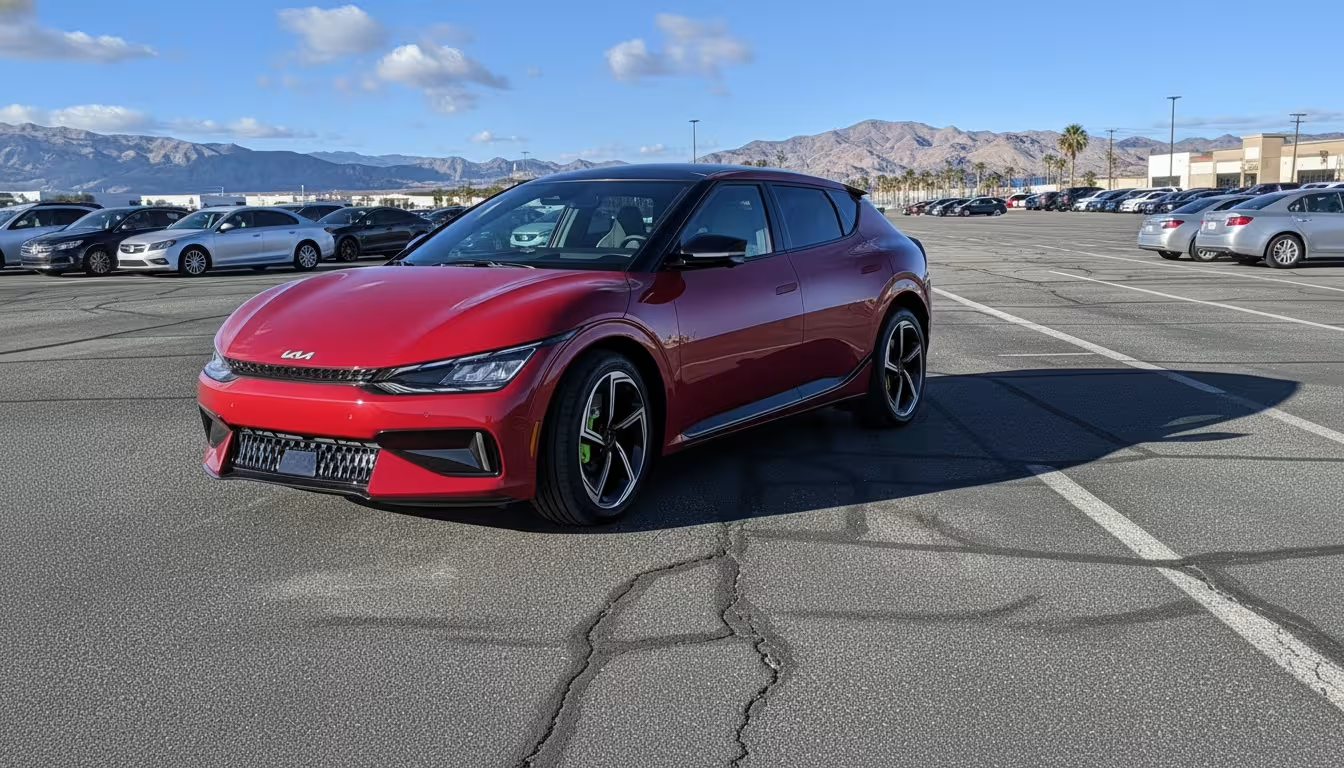
Imagine driving your brand-new electric vehicle down the highway when a loud bang echoes through the cabin and the car suddenly loses all propulsion. That’s not a hypothetical, it’s the exact nightmare at the center of a new Hyundai ICCU lawsuit that alleges a massive recall did nothing to stop a dangerous defect. Owners are now taking Hyundai, Kia, and Genesis to federal court, claiming that replacement Integrated Charging Control Units (ICCU) installed under the recall are just as defective as the original parts.
We’ve been tracking the E-GMP platform since day one, and this litigation changes everything. If you own an Ioniq 5, EV6, or any of the affected Genesis EVs, this article will give you the straight facts, a clear understanding of the risk, and the steps you need to take right now.
Quick Facts Box
| Detail | Information |
|---|---|
| Lawsuit Filed | April 21, 2026 |
| Court | U.S. District Court for the District of New Jersey |
| Defendants | Hyundai Motor Company, Kia, Genesis Motor, and supplier Hyundai Kefico |
| Affected Models | 2022–2024 Ioniq 5 & EV6, 2023–2025 Ioniq 6, 2023–2025 GV60, Electrified GV70, 2023–2024 Electrified GV80 |
| Core Allegation | Recall replacement ICCUs are equally defective |
| Status | No response from automakers yet |
What Is the Hyundai ICCU Lawsuit?
The Hyundai ICCU lawsuit is a federal class action filed on April 21, 2026, in New Jersey. It claims that Hyundai, Kia, and Genesis knowingly replaced faulty Integrated Charging Control Units with units that carry the same inherent defect. Lead plaintiffs Hayes Young and Roy Williams argue that the official NHTSA recalls, which covered over 200,000 vehicles, did not solve the problem. Instead, owners who had the recall work performed continue to experience sudden power loss, dead 12 V batteries, and vehicles that need to be towed out of limp‑home mode.
The suit names not only the automakers but also Hyundai Kefico, the component supplier that manufactured the allegedly flawed ICCUs. This signals that the plaintiffs are targeting the root cause: the design or manufacturing of the part itself, not just the software patches applied at dealerships.
What Is the ICCU and Why It Matters?
The Integrated Charging Control Unit (ICCU) is essentially the power translator inside Hyundai‑Kia‑Genesis electric vehicles built on the E‑GMP platform. It performs two critical jobs. First, it converts high‑voltage DC electricity from the traction battery down to the 12 V DC that runs the car’s lights, infotainment, and auxiliary systems. Second, it keeps the small 12 V battery charged, just like an alternator does in a gasoline‑powered car.
If you think of the ICCU as the bridge between the EV’s massive drive battery and the low‑voltage electronics that make the car usable, you immediately see why its failure is so dangerous. When the bridge collapses, the 12 V battery drains, and the vehicle either refuses to start or, far worse, shuts down while you’re in traffic.
What Is the Actual Problem With ICCU?
The lawsuit and NHTSA investigation both point to the same root issue: the ICCU is susceptible to electrical overstress and thermal cycling damage. Over time, this can cause internal components to fail without warning. When the unit goes down, the 12 V battery stops being charged. Within minutes, sometimes seconds, the battery voltage drops below the threshold needed to power the electric motor’s control electronics.
NHTSA summarized the danger bluntly:
“A loss of drive power increases the risk of a crash.”
Drivers report that the car first throws a warning like “Check Electric Vehicle System,” then either enters a low‑power limp‑home mode or cuts power entirely. In Roy Williams’ case, the failure came with a loud bang that forced him to the shoulder. That’s not a minor software bug; it’s a hard component failure.
The Hyundai ICCU problem isn’t isolated to a single model year either. Complaints span the entire 2022–2025 production range, which is exactly why the recall population kept growing through two separate NHTSA campaigns.
Which Vehicles Are Affected?
The class action specifically names these models and model years:
- 2022–2024 Hyundai Ioniq 5
- 2023–2025 Hyundai Ioniq 6
- 2022–2024 Kia EV6
- 2023–2025 Genesis GV60
- 2023–2025 Genesis Electrified GV70
- 2023–2024 Genesis Electrified GV80
Newer models like the 2026 Ioniq 9 and the refreshed Kia EV9 use a second‑generation ICCU that Hyundai says incorporates the corrective hardware changes. While no lawsuit filings explicitly name the 2026 models yet, we’re watching closely. In the meantime, you can read our full impressions of those vehicles in our 2026 Hyundai Ioniq 9 review and our Kia EV9 review.
Did Hyundai Recall Fix the ICCU Problem?
In short: No, according to the lawsuit. Hyundai and Kia launched two separate recalls. The first, in March 2024, covered approximately 147,100 vehicles. An expanded recall followed in November 2024, bringing the total to roughly 208,000 units. The remedy was supposed to include a software update designed to reduce electrical stress and, where necessary, a complete ICCU and fuse replacement.
The lawsuit alleges that the replacement ICCU hardware is “equally defective.” Owners like Hayes Young are the living proof. Young brought his 2023 Ioniq 5 SEL to the dealer for a dead 12 V battery in late 2025. The battery was replaced under warranty, but the problem returned. According to the complaint, the dealer blamed the ICCU but didn’t replace it, leaving Young with an unresolved, recurring failure.
Roy Williams’ 2025 Kia EV6 suffered a loud bang and immediate limp‑mode. After multiple software updates and even a 12 V battery replacement, the dealer finally swapped the ICCU in March 2026, months after the first incident. If the recall fix had worked, a newly built 2025 model shouldn’t have failed at all.
This is the core of the ICCU recall fix not working allegation: the recall replaced a bad part with another bad part, lulling owners into a false sense of security.
Real Owner Complaints and Symptoms
Court filings and NHTSA complaint databases are overflowing with reports that match the plaintiffs’ experiences almost word‑for‑word. Here are the warning signs you should never ignore:
- “Check Electric Vehicle System” warning appears on the instrument cluster
- “12‑volt battery voltage low – stop safely” message illuminates
- Sudden loss of propulsion power, often preceded by a loud pop or bang
- Vehicle enters limp‑home mode and cannot exceed a few miles per hour
- Car fails to start the next day, with a completely drained 12 V battery
- Multiple dealer visits for the same unresolved electrical fault
If you’ve experienced any of these symptoms, even once, treat it as a potential ICCU failure, not a one‑off anomaly.
What Should Owners Do Right Now?
We’ve put together an immediate action plan for anyone who owns an affected Hyundai, Kia, or Genesis EV.
Step 1: Check your VIN right now
Go to nhtsa.gov/recalls and enter your 17‑digit VIN. You can also use the recall lookup tools on Hyundai’s, Kia’s, or Genesis’s official owner portals. If an open ICCU recall appears, schedule service immediately, even if you’ve already had recall work done previously.
Step 2: Document everything
The moment you see a warning light, pull over safely and photograph the instrument cluster. Keep every service invoice and dealer diagnostic printout. These records are your strongest evidence if you later need to pursue a buyback or join the class action.
Step 3: Contact the automaker directly
Open a case with Hyundai Customer Care (1‑844‑340‑9741), Kia Consumer Affairs (1‑800‑333‑4542), or Genesis Customer Care (1‑844‑340‑9741). All recall‑related ICCU inspections and repairs remain free of charge regardless of warranty status.
Step 4: Insist on a clear answer from your dealer
Ask whether your car received the updated ICCU hardware or simply a same‑generation replacement. If the service advisor cannot confirm the part number changed, the fix may not be a fix at all.
Step 5: Explore your legal options
If you’ve had repeated ICCU failures, you may want to contact Squitieri & Fearon, LLP, the firm that filed the class action, or another lemon law attorney experienced in EV defect cases.
Is It Safe to Buy Hyundai/Kia EVs Now?
This is the question we’re hearing most from our readers. The answer depends heavily on which model you’re considering.
For used examples of the Ioniq 5, Ioniq 6, EV6, or affected Genesis EVs, we now recommend extra caution. Ask the seller for the vehicle’s complete recall service history. A car that has had its ICCU replaced once, and then again, should be a hard pass unless you’re prepared for the possibility of a third failure. Consider an extended warranty that explicitly covers the integrated charging system and low‑voltage electrical components.
For new 2026 models like the Ioniq 9 and the updated EV9, the picture is brighter. These vehicles use a second‑generation ICCU that was designed after the defect pattern emerged. We haven’t seen a wave of complaints on these platforms, and the absence of lawsuits naming the 2026 model year is noteworthy. However, we’re still in the early reliability window. Our long‑term verdict will depend on data from owners like you.
Hyundai and Kia have also done solid work elsewhere. Models like the 2026 Hyundai Tucson Hybrid and the Kia Sportage Hybrid continue to score well in our reliability surveys, showing that the brand’s electrified powertrains can be robust when the hardware is right. And if high‑voltage concerns are pushing you away from pure EVs entirely, you might want to read our Prologue price cut article to see how Honda is positioning its own electric crossover.
The E‑GMP cars are genuinely excellent when they work. But the ICCU saga has dented trust, and the lawsuit makes it clear that Hyundai hasn’t yet closed the book on this problem.
What AutoTechSpot Recommends Now
This Hyundai ICCU lawsuit is evolving in real time. We have reporters tracking every court filing, and we’ve already reached out to Hyundai Motor Group for comment, so far, they’ve remained silent. That silence, paired with the mounting evidence in owner complaints, makes one thing clear: if you own an affected EV, you need to treat this as an urgent, active threat.
Check your VIN on the NHTSA website today. If you own an Ioniq 5, EV6, or affected Genesis model, stay informed and document every repair. And please, share your experience in the comments below. Your story could be the one that pushes regulators and automakers to finally deliver a real fix.
Sources & Citations
Primary public references used for U.S. vehicle research on AutoTechSpot: