2026 Jeep Cherokee Delay: Lawsuit, Orders, Buyer Risk
The 2026 Jeep Cherokee production delay started with a supplier lawsuit. See what happened, why orders slipped, and what shoppers should watch.
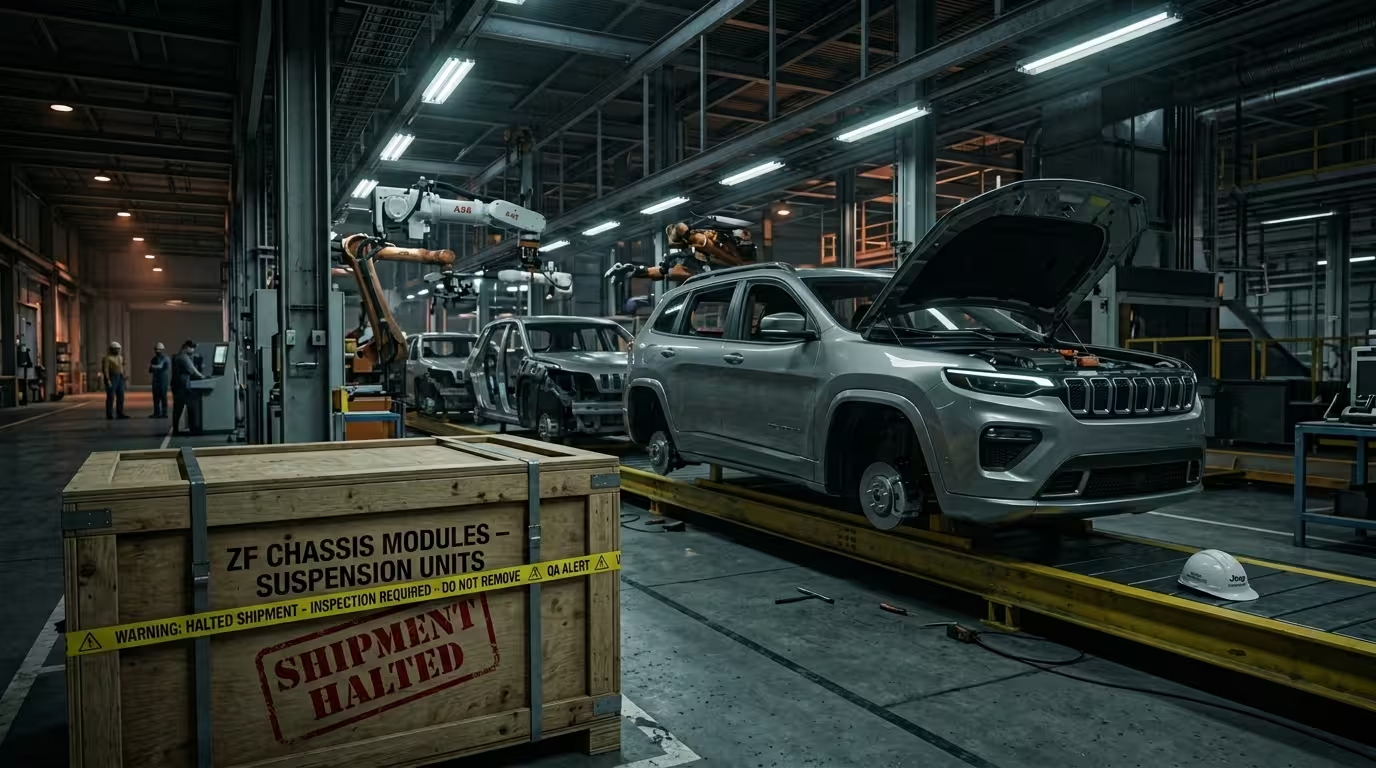
The Morning the Line Went Silent
The morning of March 14, 2026, started like any other on the assembly line at Stellantis’ Toluca, Mexico plant. Workers clocked in, robots hummed to life, and freshly painted Cherokee bodies began their slow dance toward final assembly.
Then the line stopped.
It was not a planned stoppage. It was not a quality hold. The suspension modules, the complex pre-assembled corner units that mate wheel to chassis, simply were not there. A few hours of buffer inventory evaporated, and 2,500 workers found themselves staring at unfinished vehicles.
Production halted. The reason: a supplier dispute that had escalated from a pricing disagreement into what Stellantis’ own lawyers described as a $70 million extortion attempt. For the thousands of buyers who placed early orders on Jeep’s first ever hybrid Cherokee, that moment set off a chain reaction of delays that would stretch for seven agonizing weeks.
Quick Facts: Cherokee Production Halt at a Glance
| Key Detail | Status |
|---|---|
| Production Halted | March 14, 2026 |
| Plant Location | Toluca, Mexico |
| Affected Models | Jeep Cherokee, Jeep Compass, Wagoneer S |
| Supplier Involved | ZF Chassis Modules (ZF Friedrichshafen / Foxconn JV) |
| Amount Demanded | $70 million lump sum (alleged) |
| Legal Action | Stellantis sued; Michigan court issued restraining order March 25, 2026 |
| Current Status | Production resumed early May 2026; deliveries remain delayed |
How the Relationship Unraveled
The relationship between automakers and their Tier 1 suppliers is often described as a marriage: interdependent, occasionally tense, and ruinously expensive to dissolve. The divorce between Stellantis and ZF Chassis Modules nearly became a cautionary tale for the entire industry.
ZF Chassis Modules is no small player. The company is a joint venture between Germany’s ZF Friedrichshafen, one of the world’s largest automotive suppliers, and Foxconn, the Taiwanese manufacturing giant best known for assembling iPhones. Together, they produce complete suspension corner modules for several Stellantis vehicles, including the Cherokee, Compass, Chrysler Pacifica, and Dodge Charger.
According to court documents filed in Michigan, Stellantis had already made significant concessions to keep the relationship intact. In December 2025, the automaker agreed to substantial price increases and paid more than $26 million to resolve outstanding claims. By January 2026, ZF Chassis Modules returned to the negotiating table demanding additional price hikes and compensation for volume shortfalls that Stellantis considered unjustified.
Then came the ultimatum. On March 12, the supplier informed Stellantis that all suspension module shipments would cease on March 14 unless the automaker paid an immediate $70 million lump sum. Stellantis refused, calling the demand “coercive” and “extortionate” in its lawsuit. Two days later, the Toluca plant fell silent.
Legal Firewall: The Court Steps In
A Michigan judge stepped in on March 25, issuing a temporary restraining order that forced ZF Chassis Modules to resume deliveries. However, the order only applied to Stellantis’ Windsor, Ontario plant, which builds the Pacifica and Charger. Toluca was left unprotected by that initial ruling, though Mexican courts later weighed in. An April 6 hearing was scheduled, and by early May the dispute was effectively resolved, allowing production to resume.
Timeline of the Dispute
| Date | Event |
|---|---|
| December 2025 | Stellantis pays $26M+ and agrees to price increases to avoid disruption |
| January 2026 | Supplier demands further price hikes and volume compensation |
| March 12, 2026 | ZF Chassis Modules issues stop-shipment notice effective March 14 |
| March 14, 2026 | Production halts at Toluca, Mexico plant |
| March 25, 2026 | Michigan court issues temporary restraining order for Windsor plant only |
| April 6, 2026 | Court hearing held; details remain sealed |
| Early May 2026 | Stellantis confirms production has resumed at Toluca |
Why One Part Can Stop an Entire Factory
The Toluca shutdown is not just a Jeep problem. It exposes a structural weakness that keeps automotive executives awake at night. Modern vehicles contain roughly 30,000 individual parts sourced from hundreds of suppliers worldwide. But critical systems like complete suspension modules often come from a single source. When that source decides to play hardball, the assembly line has nowhere else to turn.
Just-in-time manufacturing works brilliantly until it doesn't. Automakers chase cost savings by consolidating suppliers, but they are also consolidating risk. When a single supplier goes down, whether from a fire, a strike, or a lawsuit, the entire vehicle stops. The Cherokee's suspension modules are highly engineered assemblies that include control arms, bushings, knuckles, and brake corner components, all pre-assembled and sequenced for installation. There is no quick substitute.
Stellantis learned this lesson the hard way. The company’s $1.6 billion investment in the Toluca plant, intended to make Mexico a global export hub for the hybrid Cherokee, suddenly looked vulnerable to one joint venture’s negotiating tactics. Expect the automaker to quietly begin qualifying secondary suppliers, though those will not materialize overnight.
Supply chain issues can be just as disruptive as safety recalls. Here is proof.
Subaru Recalls 71K Forester & Crosstrek Hybrids Over Fuel Leak
The Windsor Plant: A Crisis Averted
While the spotlight was on the Cherokee, the parts freeze also threatened Stellantis' Windsor, Ontario assembly complex. That plant employs around 4,300 workers and builds the Chrysler Pacifica minivan and Dodge Charger. ZF Chassis Modules supplies the same category of suspension modules to that facility. The temporary restraining order created a legal barrier that kept Windsor running even as Toluca sat idle. The resolution of the broader dispute prevented a cascading shutdown that could have crippled two high volume plants on opposite sides of the border.
Competitor Advantage: Who Gains from Jeep's Misery?
Every delayed Cherokee is an opportunity for a rival to capture a sale. The compact hybrid SUV segment is ferociously competitive, and Jeep's prolonged absence from it after discontinuing the old Cherokee only made the battle harder. The following table shows how key competitors are positioned while Jeep struggles to fill orders.
Competitive Landscape: Compact Hybrid SUVs
| Model | Hybrid Powertrain | Key Advantage During Cherokee Delay |
|---|---|---|
| Toyota RAV4 Hybrid | 2.5L 4-cyl hybrid, AWD available | Segment leader, strong inventory, proven reliability |
| Honda CR-V Hybrid | 2.0L 4-cyl hybrid, AWD standard | Well-stocked dealer lots, refined driving manners |
| Hyundai Tucson Hybrid | 1.6L turbo hybrid, AWD | Competitive pricing, long warranty, available now |
| Kia Sportage Hybrid | 1.6L turbo hybrid, AWD | Stylish design, tech-forward cabins, comparable capability |
| Ford Escape Hybrid | 2.5L 4-cyl hybrid, AWD (discontinued after 2025) | No longer a long-term player, but clearance deals may lure buyers |
Why This Launch Matters
The 2026 Cherokee is not a mild refresh. It is the sixth-generation resurrection of a nameplate that Jeep killed after the 2023 model year. The previous Cherokee sold 89,000 units in its final year, respectable but not enough to justify continued production of an aging platform that had fallen behind the Toyota RAV4 and Honda CR-V Hybrid.
The new Cherokee was engineered from scratch to compete. Its centerpiece is a dedicated hybrid powertrain: a 1.6-liter turbocharged four-cylinder paired with two electric motors. It is Jeep's first true hybrid in the compact SUV segment, promising fuel economy competitive with the RAV4 Hybrid while delivering the Trail Rated capability that defines the brand.
Jeep dealers were counting on this vehicle. The compact SUV segment is the industry's largest and most profitable, and Jeep had been effectively absent from it since the old Cherokee bowed out. The $1.6 billion investment in Toluca was meant to turn Mexico into a global export hub. Instead, the plant sat idle for seven weeks at the worst possible moment.
The Dealer's Plight: Empty Lots and Escaping Buyers
Before the shutdown, dealer inventory was already razor thin: just a 25-day supply, well below the 60-day industry norm. The seven-week hole in production essentially drained whatever buffer existed. Some dealers received a handful of units before the stoppage; others received none at all.
One Midwest Jeep dealer, speaking anonymously because Stellantis discourages unauthorized media contact, told us:
"We have customers who ordered in January. They were promised delivery in March or April. Now we're telling them maybe June or July. Some are understanding. Others are walking across the street to the Toyota store."
That last point stings. Jeep's brand loyalty is legendary, but loyalty has limits when a family needs a vehicle now and the alternative is a seven-month wait.
What the Restart Means for Your Order
Production resumed in early May 2026. A Stellantis spokesperson confirmed the restart, and finished Cherokees are once again rolling off the line. However, a just-in-time production system optimized for steady flow cannot simply sprint after a seven-week nap. Even at full speed, Toluca can only build so many Cherokees per day, and those vehicles must compete for logistics capacity with the Compass and Wagoneer S produced on the same line.
Dealers have been told to prioritize the oldest customer orders first. That means anyone placing a new order today may not see their Cherokee until late summer or early fall. Some high demand trims with specific option packages could take even longer.
Estimated Delivery Impact for Buyer
| Order Timing | Estimated Delivery Window (As of May 2026) |
|---|---|
| Orders placed before January 2026 | June – July 2026 (priority fulfillment) |
| Orders placed January – March 2026 | July – August 2026 |
| New orders (May 2026 onward) | September – October 2026 |
| Limited edition/high-demand trims | Add 4-8 weeks to base estimate |
Actionable Steps for Waiting Buyers
Contact your dealer immediately. Ask for an updated delivery timeline and a vehicle order status report. If your salesperson cannot provide concrete information, ask to speak with the sales manager or the dealership’s inventory specialist. Get everything in writing. Verbal promises about delivery dates are meaningless. Request an email confirming your order status, estimated build date, and current position in the dealer's allocation queue. Consider your alternatives. If your current vehicle lease is ending or you urgently need transportation, ask the dealer about available Cherokee units that may match your preferences closely enough. A different color or option package might arrive weeks earlier than your exact custom order. Do not panic, but stay proactive. The Cherokee is back in production and units are shipping. The situation is improving, but the pace of recovery will vary by region, dealer, and configuration. Staying informed and engaged is your best strategy.The Bigger Industry Picture
The Cherokee production halt is a warning shot for an industry that has grown dangerously dependent on single-source suppliers for complex, critical components. The post-pandemic shift toward electrification has only intensified this dependency. Hybrid and electric powertrains require specialized components that often come from a handful of global suppliers. Consolidation among Tier 1 suppliers, driven by the enormous capital requirements of EV development, is narrowing the field further.
When ZF and Foxconn formed their chassis modules joint venture, the rationale was compelling: combine German engineering expertise with Foxconn's manufacturing scale and cost discipline. But the Toluca shutdown reveals the dark side of that consolidation. A joint venture between two corporate giants can wield enormous leverage over an automaker, especially when it supplies multiple high-volume vehicle lines.
Other automakers are undoubtedly watching this case closely. Toyota, which famously diversified its supply base and maintains deeper inventory buffers after the 2011 Fukushima disaster, may look prescient. Hyundai and Kia, which have invested heavily in vertical integration through their affiliated Hyundai Mobis supplier, may feel vindicated. Stellantis, which under CEO Carlos Tavares has pursued aggressive cost-cutting through supplier consolidation, may need to reconsider its approach.
Jeep's Reputational Reckoning
Jeep has weathered plenty of storms over its 80-plus-year history: world wars, ownership changes, bankruptcies, and market collapses. The brand's resilience is legendary. But this supplier dispute strikes at a particularly vulnerable moment.
The Cherokee relaunch was supposed to signal that Jeep is serious about electrification and ready to compete in the mainstream compact SUV segment it abandoned three years ago. Instead, the narrative shifted from "Jeep is back" to "Jeep cannot deliver." Production has resumed, and the Cherokee remains an excellent product on paper. But in the automotive business, great products are necessary but not sufficient. You also need to build them, ship them, and get them into customers' hands before they lose patience.
Stellantis won its courtroom battle, or at least achieved a truce. The harder fight, winning back the trust of buyers who watched their delivery dates slip by months, is just beginning.
Disclaimer: Information based on reports as of April 2026. Automaker product plans are subject to change. Always confirm with official sources.
Sources & Citations
Primary public references used for U.S. vehicle research on AutoTechSpot: