2026 Honda Odyssey Review Is the Last Non Hybrid Minivan Still Worth Buying
The 2026 Honda Odyssey is quicker than every hybrid minivan on sale, but higher fuel costs and no AWD could be dealbreakers. See how it compares to the Toyota Sienna, Kia Carnival, and Chrysler Pacifica.
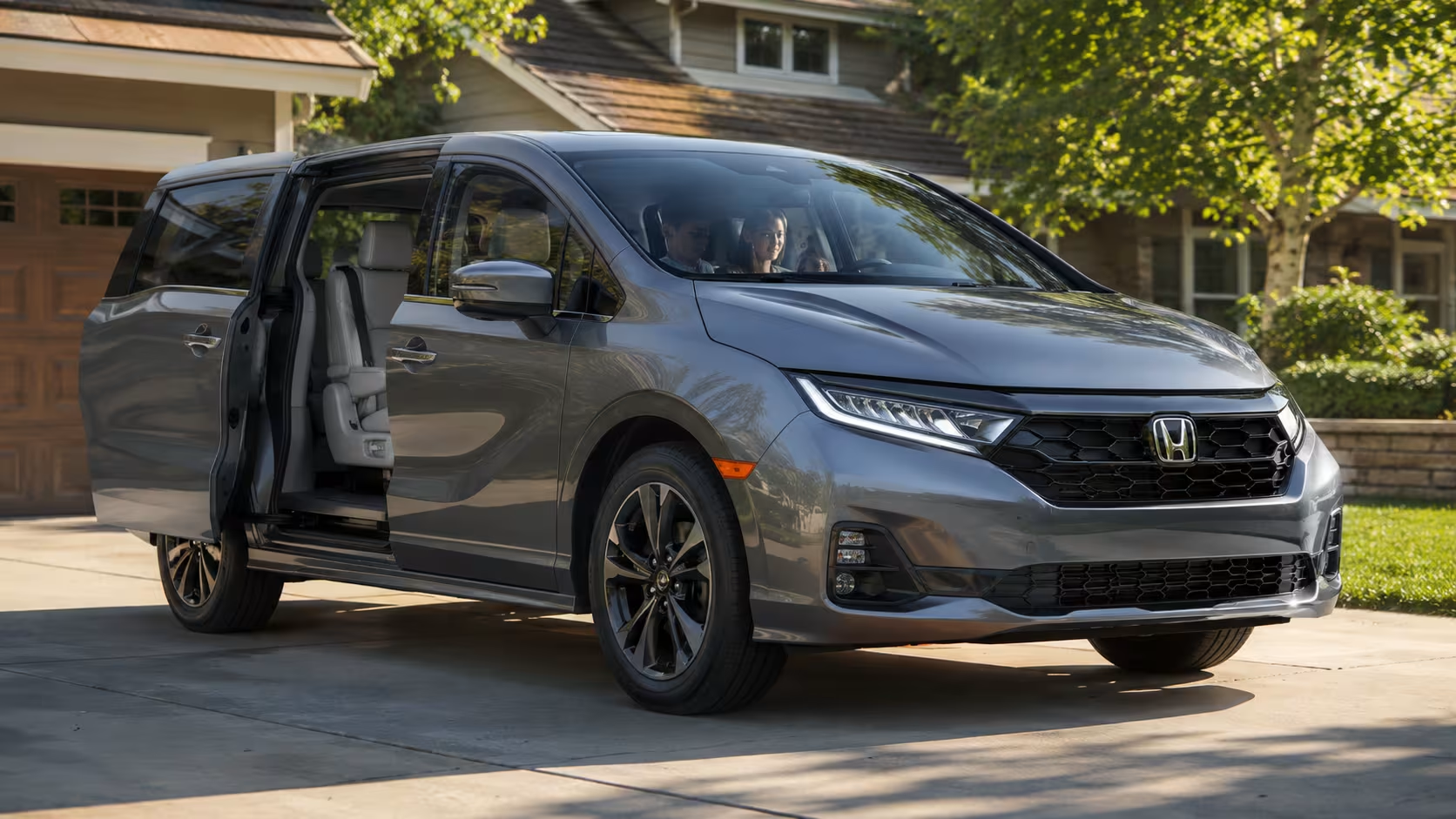
The 2026 Honda Odyssey feels like an old-school answer to a very modern question: do families really need hybrids, AWD, and SUV styling, or do they just need a minivan that works brilliantly every day? Honda sticks with a proven V6, front-wheel drive, standard eight-passenger seating, and its clever Magic Slide second-row seats. That makes the Odyssey quick, practical, and refreshingly simple. But with rivals offering better fuel economy, available AWD, and newer platforms, its traditional formula now comes with real trade-offs.
In this review, we break down the 2026 Odyssey’s performance, comfort, safety, cargo space, ownership costs, and family-friendly features to see whether Honda’s classic minivan still deserves a top spot on your shopping list.
2026 Honda Odyssey Pricing and Trims
Honda offers the 2026 Odyssey in four trims, all powered by the same V6 and 10‑speed automatic. No new features arrived for the new model year, but average MSRPs rose about $550 across the board.
| Trim | MSRP (before destination) | MSRP with $1,450 destination |
|---|---|---|
| EX‑L | $42,795 | $44,245 |
| Sport‑L | $43,895 | $45,345 |
| Touring | $47,495 | $48,945 |
| Elite | $51,695 | $53,145 |
The pricing context is important. The base Odyssey now costs over $3,000 more than a Toyota Sienna and nearly $2,000 more than a Kia Carnival Hybrid. If monthly budget is the primary concern, our Car Loan Calculator translates these figures into real payments.
Powertrain and Performance
The Odyssey’s 3.5‑liter V6 produces 280 hp at 6,000 rpm and 262 lb‑ft of torque at 4,700 rpm. The 10‑speed automatic shifts smoothly through the gears, rarely hunting even on long grades. Car and Driver recorded a 6.4‑second sprint to 60 mph, a figure that translates directly into confident freeway merging and stress‑free passing on two‑lane roads. The engine runs on regular 87‑octane fuel, keeping daily operating costs manageable.
Handling, Ride Quality, and Ground Clearance
What distinguishes the Odyssey from its rivals is how it manages its mass. The steering offers precise, well‑weighted response with genuine on‑center feel. Body control through curves is impressive for a vehicle designed to carry up to eight passengers. The suspension absorbs broken pavement without introducing excessive float, and wind noise at highway speeds remains low enough that third‑row conversations stay easy particularly on Elite models with their additional acoustic glass. Ground clearance is a segment‑typical 7.3 inches, adequate for most conditions but worth noting if deep snow or rough unpaved roads are part of your routine.
Towing Capacity
Towing capacity is a genuine differentiator. Every Odyssey can pull 3,500 lbs, matching the Chrysler Pacifica and exceeding the capability of many three‑row crossovers without a tow package. For families who need to haul a small camper, a pair of jet skis, or a utility trailer, that capability is meaningful.
Lack of All-Wheel Drive
All‑wheel drive is not offered, a significant omission for buyers in snow‑belt states. Intelligent Traction Management with Snow Mode helps with initial grip, but it cannot replicate the year‑round confidence of a driven rear axle. Families who face severe winters should weigh this limitation carefully.
Fuel Economy
The EPA rates the Odyssey at 19 mpg city, 28 mpg highway, and 22 mpg combined. Typical mixed driving returns hover around 21 mpg, closely matching the official estimate. That figure is acceptable for a powerful V6 the non‑hybrid Pacifica matches it, and the non‑hybrid Carnival trails by a single mpg but the broader minivan segment has moved on.
The Toyota Sienna’s hybrid system achieves up to 36 mpg combined, and the Carnival Hybrid delivers an estimated 33 mpg. Over 15,000 miles a year, the fuel cost gap between an Odyssey and a Sienna can easily exceed $600, depending on local fuel prices. The 19.5‑gallon fuel tank provides a highway cruising range beyond 500 miles, reducing the frequency of fuel stops on long road trips. For a personalized cost comparison, use our Fuel Cost & Savings Calculator.
Safety
The NHTSA awards the 2026 Odyssey a 5‑star overall rating, and the IIHS designates it a Top Safety Pick. Those accolades come with an important caveat. In the IIHS’s updated moderate overlap front test, rear passenger protection earned a Poor rating. That result indicates elevated injury risk for occupants in the second and third rows during certain frontal collisions a finding that matters in vehicles routinely used to transport children. Both the 2026 Toyota Sienna and Kia Carnival achieved Good ratings in the same evaluation, including rear passenger protection.
Standard Honda Sensing Safety Features
Honda Sensing, standard on every trim, provides a comprehensive active safety suite: forward‑collision warning with pedestrian detection, automatic emergency braking, adaptive cruise control, lane‑centering steering, blind‑spot monitors, rear cross‑traffic alert, road‑sign recognition, and automatic high beams. The lane‑centering function tracks accurately without the wandering that affects some competitor systems, and adaptive cruise control decelerates smoothly in traffic.
Driver Visibility and Sightlines
Visibility is another strength. Large windows, slim pillars, and a relatively low beltline give the driver an expansive view of surrounding traffic a tangible advantage over many three‑row SUVs that trade sightlines for styling.
Interior, Cargo and Technology
The Odyssey’s defining interior feature is the Magic Slide second‑row seating. The outboard seats move laterally 12.9 inches and fore/aft, enabling parents to position a child closer for easier access. Removing the center section converts the bench into captain’s chairs. LATCH anchors are clearly marked and accessible, making child seat installation straightforward a practical benefit for families with multiple young children.
Seating Comfort and Ride Quality
Front seats offer wide cushions and sufficient support to remain comfortable during multi‑hour highway drives. The third row accommodates average‑sized adults without forcing knees toward the chest. Ride quality contributes meaningfully to road trip comfort, with a suspension that effectively isolates passengers from coarse pavement.
Cargo Space and Seat Flexibility
Behind the third row, cargo capacity measures 32.8 cubic feet enough for a full grocery run, a stroller, and several carry‑on bags. Fold the third row flat and remove the second‑row seats, and total volume expands to a class‑leading 158 cubic feet. The trade‑off is that those second‑row seats are heavy and must be physically removed and stored; they do not fold into the floor. The Chrysler Pacifica’s Stow ’n Go system still holds the advantage in outright convenience.
Infotainment and Family Technology
Infotainment centers on a 9‑inch touchscreen with wireless Apple CarPlay and Android Auto as standard. Response times are quick, and the interface remains simple enough to operate without distraction. Upper trims offer a 12.8‑inch rear entertainment system, and the Touring’s CabinWatch camera provides a clear view of second‑ and third‑row occupants a useful feature for parents who prefer to monitor children without turning around at highway speeds.
What’s New for 2026?
The 2026 Honda Odyssey carries over unchanged from the 2025 model year. The 2025 refresh updated the front and rear styling, enlarged the touchscreen, and added standard wireless smartphone integration. For 2026, the only change is the average $550 price increase. On a platform that is now among the oldest in the segment, that lack of advancement is increasingly difficult to overlook. Stagnation typically depresses resale values over time, though the Odyssey’s historically strong reputation provides some cushion.
Honda Odyssey vs. The Competition
| Model | Starting MSRP (incl. dest.) | Horsepower | Fuel Economy (comb.) | Drivetrain Options | Warranty (Powertrain) | Signature Feature |
|---|---|---|---|---|---|---|
| 2026 Honda Odyssey | $44,245 | 280 hp | 22 mpg | FWD only | 5 yrs / 60,000 mi | Magic Slide seats |
| 2026 Toyota Sienna | ~$39,000 | 245 hp (hybrid) | 36 mpg | FWD or AWD | 5 yrs / 60,000 mi | Standard hybrid AWD |
| 2026 Kia Carnival Hybrid | ~$42,000 | 242 hp (hybrid) | 33 mpg (est.) | FWD only | 10 yrs / 100,000 mi | Modern design, value |
| 2026 Chrysler Pacifica (non‑hybrid) | ~$38,500 | 287 hp | 22 mpg | FWD or AWD | 5 yrs / 60,000 mi | Stow ’n Go seats |
Honda Odyssey vs. Three‑Row SUV: Which Is the Better Family Vehicle?
Many families cross‑shop minivans against three‑row SUVs like the Honda Pilot, Toyota Highlander, and Kia Telluride. The choice often comes down to packaging priorities.
Minivan Advantages for Family Use
A minivan like the Odyssey offers a significantly lower load floor, making it easier for children and older adults to climb in and out. Power sliding doors eliminate door‑ding worries in tight parking spaces and provide wide openings for installing child seats. The Odyssey’s 158 cubic feet of maximum cargo space surpasses nearly every three‑row SUV on the market, and its third row is genuinely adult‑usable, not an occasional jump seat.
Three-Row SUV Advantages
Three‑row SUVs counter with available all‑wheel drive, higher ground clearance for rough roads or deep snow, and a driving position many buyers prefer. A Honda Pilot, for example, offers 8.3 inches of ground clearance and torque‑vectoring AWD, making it a more confident choice in poor weather or on unpaved surfaces. Fuel economy often tilts in the minivan’s favor compared to V6‑powered SUVs, though hybrid SUV options are increasingly available.
Which One Makes More Sense?
For families who prioritize maximum interior space, daily usability, and the easiest possible access for children, a minivan like the Odyssey remains the smarter tool. If all‑weather capability, a higher driving position, or towing beyond 3,500 lbs matter more, a three‑row SUV deserves the test drive.
Reliability, Resale Value, and Ownership Costs
The Odyssey benefits from an above‑average reliability record. In J.D. Power’s latest Vehicle Dependability Study, it scored above the segment average, reinforcing Honda’s reputation for long‑term durability. Resale values have historically been among the strongest in the minivan class, according to Kelley Blue Book residual value projections.
Fuel and Maintenance Costs
Ownership costs deserve a closer look. The biggest recurring expense is fuel; compared to a Sienna, the Odyssey’s 22 mpg combined can add over $600 annually to the fuel bill at current prices. Maintenance presents a mixed picture. Routine service costs are moderate, but the V6 uses a timing belt that requires replacement every 7 years or 100,000 miles a job typically costing between $800 and $1,200 at a dealership. Hybrid powertrains and timing‑chain designs avoid this expense entirely.
Insurance and Warranty Coverage
Insurance premiums for the Odyssey tend to be lower than those for comparable three‑row SUVs, reflecting the minivan’s family‑friendly profile and strong safety history. Honda’s warranty 3 years/36,000 miles basic and 5 years/60,000 miles powertrain matches Toyota and Chrysler but falls well short of Kia’s 10‑year/100,000‑mile powertrain coverage. If you intend to keep the vehicle beyond the factory warranty period, that difference matters.
Expert‑Verified Pros and Cons
Pros
- Class‑leading acceleration: 0‑60 mph in 6.4 seconds
- Magic Slide seats provide unmatched second‑row flexibility
- Standard 8‑passenger seating on every trim
- Maximum 158 cubic feet of cargo room, best in class
- 3,500‑lb towing capability
- Smooth, immediate V6 power without the droning common in hybrid CVTs
- Agile handling and a composed ride
- Above‑average reliability per J.D. Power and strong resale value projections
Cons
- No hybrid option: worst fuel economy among current minivans
- No AWD availability
- Second‑row seats must be physically removed for maximum cargo; they don’t fold flat
- IIHS rear passenger protection rated Poor (rivals scored Good)
- Starting price exceeds all key competitors by thousands
- Dated platform with no new features for 2026 despite a price increase
- Timing belt replacement adds a notable maintenance expense at 7 years or 100,000 miles
Who Should Buy the 2026 Honda Odyssey?
The Odyssey suits families who value driving engagement, interior flexibility, and proven reliability above all else. If standard eight‑passenger seating, a 3,500‑lb towing capacity, and the ability to reconfigure the second row in seconds are priorities, the Odyssey remains an excellent choice. Its V6 delivers smooth, responsive power that makes daily commuting and highway travel genuinely pleasant, and ride quality holds up well over long distances.
Who Should Skip It?
Look elsewhere if fuel costs, all‑wheel‑drive security, or the latest crash‑test scores are dealbreakers. The Toyota Sienna provides hybrid efficiency and available AWD at a lower price. The Kia Carnival Hybrid offers modern styling, better fuel economy, and a much longer warranty. The Chrysler Pacifica delivers Stow ’n Go convenience and an available plug‑in hybrid powertrain. Families weighing a minivan vs SUV should also consider that the Odyssey’s lack of AWD and moderate ground clearance may not suit their needs if they frequently travel in winter weather or on unpaved roads. Finally, if long‑term ownership is the plan, factor in the timing‑belt replacement cost.
Ready to decide? Estimate monthly payments with our Car Loan Calculator, browse local Honda dealer inventory, and if you’re still unsure between a minivan and an SUV, our What Car Suits Me? Quiz will guide you.
Information based on data available as of June 2026. Specifications and pricing subject to change. Always verify with your local dealer before purchase.Sources & Citations
Primary public references used for U.S. vehicle research on AutoTechSpot: