2027 Toyota 4Runner Review: The Rugged SUV Is Back With Hybrid Torque and Serious Trail Muscle
The 2027 Toyota 4Runner keeps its legendary off-road DNA but adds a modern cabin, stronger turbo power, and an available hybrid system with serious torque.
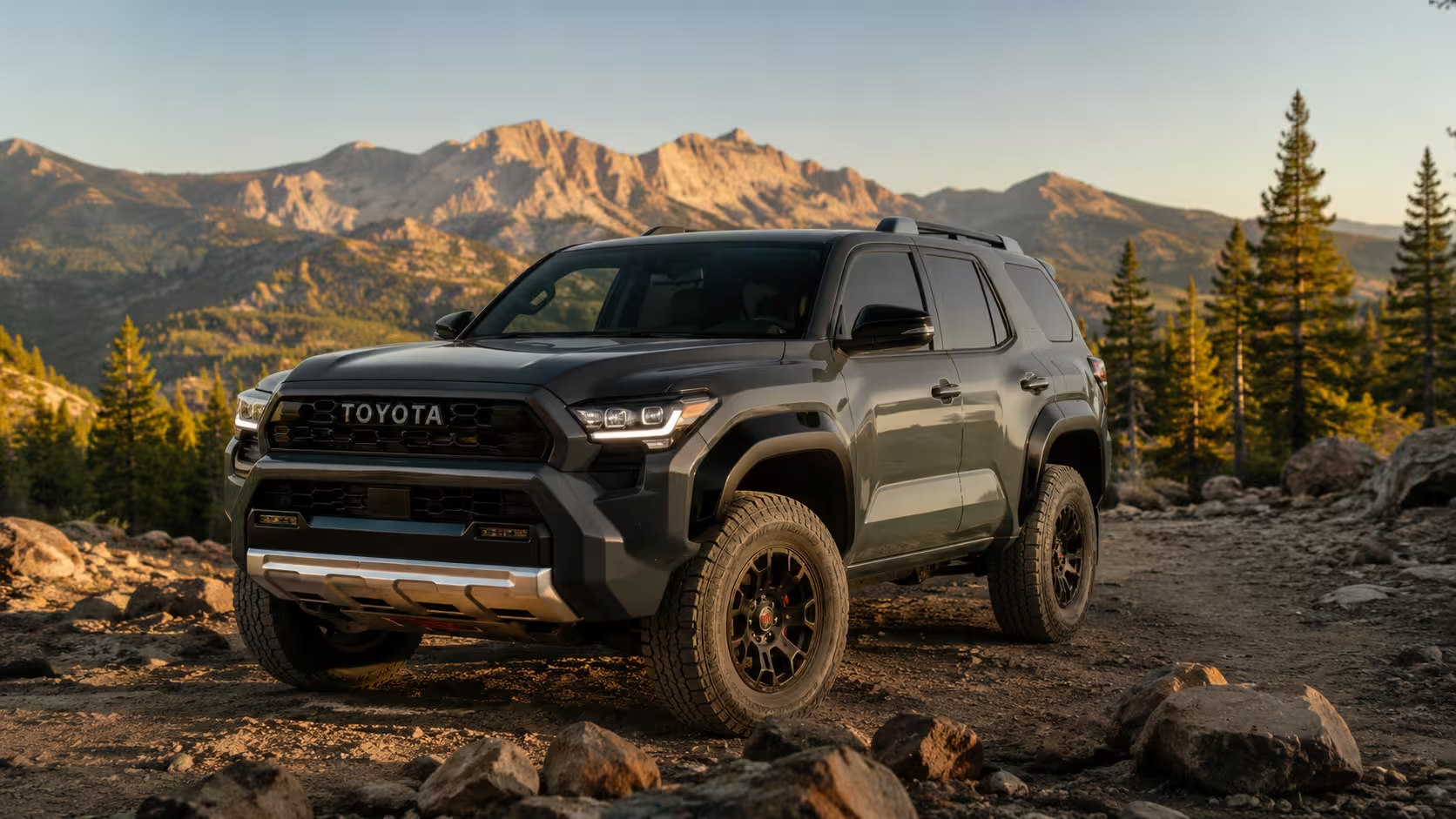
The Toyota 4Runner has never been the SUV for people who only want a soft ride and a quiet commute. It is for buyers who want a machine that can handle dirt roads, rocky trails, camping weekends, towing duty, and years of hard use.
For 2027, the 4Runner is expected to continue the current sixth-generation formula that finally replaced the old fifth-generation model after roughly 15 years. That means a stronger TNGA-F platform, modern technology, serious off-road hardware, and an available i-FORCE MAX hybrid with the torque this SUV always needed.
Note: Toyota has not yet released a full official 2027 Toyota 4Runner specification sheet. This review is based on confirmed sixth-generation 4Runner data, current 2026 pricing and specifications, and early 2027 expert projections.2027 Toyota 4Runner Specs Buyers Need to Know
The 2027 Toyota 4Runner is expected to remain a rugged body-on-frame SUV with real trail capability and better daily usability than before. It still targets buyers who want function, durability, and adventure credibility.
| Category | Expected 2027 Toyota 4Runner Details |
|---|---|
| Starting MSRP | Estimated low-to-mid $40,000 range, based on current 2026 pricing |
| Standard engine | 2.4L turbocharged four-cylinder |
| Standard output | 278 hp and 317 lb-ft |
| Hybrid powertrain | 2.4L turbo i-FORCE MAX hybrid |
| Hybrid output | 326 hp and 465 lb-ft |
| Fuel economy | Gas models around 21 to 22 mpg combined, hybrid around 23 mpg combined |
| Seating | 5 passengers standard, available 7-passenger seating on select non-hybrid models |
| Drivetrain | RWD, part-time 4WD, or full-time 4WD depending on trim |
| Ground clearance | Up to 10.1 inches |
| Towing capacity | Up to 6,000 lbs |
| Key trims | SR5, TRD Sport, TRD Off-Road, Limited, Platinum, Trailhunter, TRD Pro |
The 4Runner Finally Feels Modern Without Going Soft
The Toyota 4Runner built its reputation by being honest. It was never the fanciest SUV in the segment, but it became a favorite because it was tough, dependable, and ready for places most crossovers should avoid.
The new-generation model keeps that identity while fixing many of the old truck’s weaknesses. It now has better technology, stronger powertrains, improved safety features, and a cabin that no longer feels a decade behind.
A Long-Awaited Redesign With Real Purpose
The current 4Runner belongs to the sixth generation, and that matters more than the styling. Toyota moved the SUV to the TNGA-F platform, giving it the truck-based structure needed for towing, trail driving, and long-term durability.
One reason the 4Runner still stands out is that very few mainstream SUVs use body-on-frame construction anymore. Most rivals have moved toward crossover platforms that favor comfort and efficiency over off-road toughness.
Toyota did not turn the 4Runner into a soft family hauler. It modernized the formula with better steering feel, updated suspension tuning, larger screens, Toyota Safety Sense 3.0, and an available hybrid system that adds serious torque.
Pricing and Trims
Toyota has not confirmed official 2027 pricing yet, so current sixth-generation pricing is the best guide. Expect the 2027 4Runner price to start in the low-to-mid $40,000 range and climb close to $70,000 for the most specialized hybrid off-road trims.
| Trim | Estimated Price Range | Best For | Key Features |
|---|---|---|---|
| SR5 | Low-to-mid $40,000s | Entry-level buyers | Standard turbo engine, modern safety tech, available third row |
| TRD Sport | High $40,000s | Street-focused buyers | Sportier styling, road-focused suspension tuning |
| TRD Sport Premium | Low-to-mid $50,000s | Comfort-focused buyers | Larger screen, more convenience features |
| TRD Off-Road | Low $50,000s | Best value for trail use | 4WD hardware, off-road suspension, Multi-Terrain Select, Crawl Control |
| TRD Off-Road Premium | Mid-to-high $50,000s | Trail use plus comfort | Better cabin features, available hybrid, advanced trail tech |
| Limited | High $50,000s to low $60,000s | Daily driving | More luxury, comfort features, available hybrid |
| Platinum | Mid $60,000s | Premium hybrid buyers | Hybrid power, upscale interior, road-focused comfort |
| Trailhunter | Upper $60,000s | Overlanding | Factory overlanding hardware, ARB gear, Old Man Emu suspension |
| TRD Pro | Upper $60,000s | Hardcore off-road fans | FOX shocks, 33-inch tires, aggressive off-road tuning |
Choose the Limited if you want a more comfortable daily driver with 4Runner capability in reserve. Choose the Trailhunter if overlanding is part of your lifestyle. Choose the TRD Pro if you want the most aggressive factory off-road personality and are willing to pay for it.
Before you choose a trim, Use our Car Loan Calculator to estimate your monthly payment. The price gap between a TRD Off-Road and a TRD Pro can make a major difference in your monthly budget.
Powertrain and Performance
The new-generation 4Runner no longer uses the old V6. The standard engine is a 2.4-liter turbocharged four-cylinder producing 278 hp and 317 lb-ft of torque through an 8-speed automatic transmission.
The i-FORCE MAX hybrid is the powertrain that changes the SUV’s personality. It produces 326 hp and 465 lb-ft of torque, making it the strongest 4Runner powertrain currently available.
That extra torque is useful in the real world. Around town, the hybrid feels more responsive. On trails, it helps the 4Runner crawl, climb, and pull through rough surfaces with less effort.
Expert testing has shown gas models around the mid 7-second range from 0 to 60 mph, while the hybrid can run closer to 6.7 seconds. It still drives like a truck-based SUV, but it no longer feels slow or outdated.
Fuel Economy
The 4Runner hybrid helps fuel economy, but it is not designed to be a maximum-mpg commuter SUV. This is a torque-focused hybrid built for capability. Gas models are expected around 21 to 22 mpg combined, depending on trim and drivetrain. Hybrid models are expected around 23 mpg combined, with current estimates near 23 city / 24 highway mpg.
The hybrid’s real benefit is balance. You get stronger acceleration and better low-speed response without paying a huge fuel-economy penalty. Real-world mpg will depend on how the SUV is used. All-terrain tires, roof racks, lift kits, camping gear, steel bumpers, and towing can all reduce efficiency.
If you are comparing gas and hybrid trims, Try our Fuel Cost & Savings Calculator to see your annual fuel savings before paying the hybrid premium.
Interior and Technology
The cabin is one of the most welcome upgrades. The new 4Runner still feels practical and upright, but the screens, controls, materials, and available features are far more competitive.
Depending on trim, buyers can get an 8-inch or available 14-inch touchscreen, wireless Apple CarPlay, wireless Android Auto, USB-C ports, an available digital gauge cluster, heated and ventilated seats, and Toyota’s signature power rear window.
The hybrid has one important compromise. Its battery placement reduces cargo flexibility and removes the third-row option from hybrid models.
The available third row in non-hybrid versions is best for kids or occasional short trips. If you need real third-row comfort, our Telluride review covers a family-friendly alternative.
Off-Road Capability
The 4Runner remains one of the few mainstream SUVs built for real trail work. Its body-on-frame construction, available four-wheel-drive systems, off-road suspension choices, and trail software give it credibility that most crossovers cannot match.
Depending on trim, buyers can get part-time 4WD, full-time 4WD, a two-speed transfer case, an electronic locking rear differential, Multi-Terrain Select, Crawl Control, Downhill Assist Control, a Multi-Terrain Monitor, and an available Stabilizer Disconnect Mechanism.
The TRD Off-Road is the smart choice for most weekend adventurers. It gives you the core trail tools without forcing you into the highest price range. The Trailhunter is the overlanding trim, aimed at buyers who want factory adventure equipment. The TRD Pro is the more aggressive off-road flagship with a stronger performance image.
Many buyers do not need the most extreme version. A TRD Off-Road with proper tires, recovery gear, and driver training will be more useful than an expensive build loaded with accessories that add weight, noise, and fuel cost.
Safety
The 4Runner now offers the kind of safety technology buyers expect in a modern SUV. Toyota Safety Sense 3.0 is a meaningful upgrade over the older generation.
Expected features include automatic emergency braking, adaptive cruise control, lane assistance, road sign assist, blind-spot monitoring, rear cross-traffic alert, and available camera-based visibility features depending on trim.
Final 2027 crash-test ratings should still be checked when available. For now, the safer statement is that the current-generation 4Runner has a much stronger active-safety package than before.
4Runner vs. Rivals: Which Adventure Vehicle Should You Actually Buy?
The 4Runner competes with several vehicles that solve different problems. Some are off-road SUVs, some are family crossovers, and one is a truck that appeals to the same outdoor crowd.
| Model | Best For | Off-Road Capability | Daily Comfort | Fuel Economy | Practical Buying Advice |
|---|---|---|---|---|---|
| Toyota 4Runner | Adventure SUV buyers | Excellent | Improved but still trucklike | Moderate | Choose it for Toyota reliability, body-on-frame strength, towing, resale value, and enclosed cargo space |
| Ford Bronco | Open-air off-road fun | Excellent | Rugged | Moderate | Choose it if removable-roof personality matters more than cargo comfort and Toyota resale value |
| Jeep Wrangler | Hardcore trail character | Excellent | Least refined | Moderate to low | Choose it if rock crawling and removable-door adventure are your top priorities |
| Chevrolet Colorado ZR2 | Off-road truck buyers | Excellent | Trucklike | Moderate | Choose it if you need a pickup bed, payload flexibility, and dirty-gear utility |
| Toyota Grand Highlander Hybrid MAX | Family hybrid buyers | Limited | Excellent | Better than 4Runner | Choose it if you want Toyota hybrid power with real family space |
| Kia Telluride | Family comfort | Light-duty only | Excellent | Road-focused | Choose it if comfort, third-row space, and value matter more than trail capability |
The Jeep Wrangler is still the purist’s trail toy. It is the better choice for removable-door fun and serious rock crawling, but the 4Runner is easier to live with as an everyday SUV.
The Chevrolet Colorado ZR2 is the better tool if you need a truck bed. It makes sense for buyers who carry bikes, tools, dirty camping gear, or work equipment.
The Toyota Grand Highlander and Kia Telluride are better for family life. If you want a smoother three-row SUV, our Palisade Hybrid review covers a road-focused three-row SUV, while our Grand Highlander review is the better choice for families who want Toyota hybrid power without the 4Runner's trucklike compromises.
Ownership Costs
The 4Runner should be cheaper to own than many luxury off-road SUVs, but it will not be as cheap as a basic crossover. Insurance, tires, fuel, accessories, and trim choice matter. Insurance will likely cost more on TRD Pro, Trailhunter, Platinum, and hybrid models because these trims have higher replacement values. Get quotes before buying, especially if you plan to finance.
Fuel costs will be moderate. The hybrid improves response and slightly improves efficiency, but it is not a dramatic fuel saver compared with road-focused hybrid SUVs. Gas models may cost less up front. Hybrid models cost more but offer stronger torque, better city response, and Toyota’s hybrid experience.
Tires are a real ownership cost. All-terrain tires on off-road trims can be more expensive than normal SUV tires, and larger aftermarket tires can reduce mpg and increase road noise. Toyota’s dealer network is a major advantage for long-term owners. Toyota also offers strong hybrid battery coverage, with hybrid battery warranty coverage listed at 10 years or 150,000 miles.
Resale value is one of the 4Runner’s strongest financial arguments. The 4Runner has a long reputation for strong SUV resale value, which can reduce the true cost of ownership.
Who Should Buy the 2027 Toyota 4Runner?
Buy the 4Runner if your life includes trails, camping, towing, outdoor gear, or rough-road travel. It makes the most sense for people who will use its capability.
Outdoor families will like its toughness, cargo space, roof-rack potential, and available third row on select non-hybrid models. Campers and weekend adventurers will appreciate the towing rating, power rear window, and trail-ready trims.
Overlanders should consider the Trailhunter, but the TRD Off-Road may be the smarter starting point if you want to build your own setup. Towing users should also look closely at the 6,000-lb rating, while still checking payload, tongue weight, and trailer requirements.
Who Should Skip the 2027 Toyota 4Runner?
Skip the 4Runner if your driving is mostly city commuting. It is larger, heavier, and more trucklike than a typical crossover.
Fuel-economy-focused buyers should also look elsewhere. The hybrid helps, but it does not turn the 4Runner into a high-mpg family SUV.
Luxury-focused buyers may prefer a Lexus GX, Grand Highlander, Palisade, or Telluride. Families needing a true third row should also skip it because the 4Runner’s available third row is tight, and hybrid models do not offer one.
Pros and Cons
The new-generation 4Runner is much better than before, but it still has a clear mission. It is an adventure SUV first and a family crossover second.
Pros
- Legendary Toyota 4Runner off-road capability
- Current sixth generation platform after roughly 15 years
- Available i-FORCE MAX hybrid with 326 hp and 465 lb-ft
- Better on-road manners than the old 4Runner
- Strong body-on-frame SUV durability
- Modern infotainment and safety technology
- Useful trims for trail driving, overlanding, and towing
- Toyota reliability reputation and strong SUV resale value
- Up to 6,000 lbs towing capacity
- Up to 10.1 inches of ground clearance
Cons
- Hybrid battery reduces cargo flexibility
- Hybrid models do not offer a third row
- Available third row is tight
- Fuel economy still trails car-based hybrid SUVs
- Upper trims are expensive
- Ride and handling are still trucklike
- Off-road tires and accessories can increase ownership costs
The 4Runner Is Back Where It Belongs
Yes, you should buy the 2027 Toyota 4Runner if you want a real adventure SUV with Toyota durability, serious off-road capability, strong resale value, and available hybrid torque.
The TRD Off-Road is the best all-around value for most buyers. It has the right hardware, the right personality, and a price that makes more sense than the high-end off-road trims.
The Trailhunter is the best fit for overlanding buyers who want factory adventure gear. The TRD Pro is for buyers who want the most aggressive factory off-road setup and do not mind paying for it.
Skip the 4Runner if you mainly need third-row comfort, quiet highway cruising, or maximum fuel economy. In that case, a Telluride, Palisade Hybrid, or Grand Highlander Hybrid MAX will be easier to live with.
Still deciding? Take our 2-minute What Car Suits Me? Quiz to see whether a rugged 4Runner or a family-friendly crossover fits your lifestyle better.
Ready to hit the trail in the new-generation Toyota 4Runner? Use our Car Loan Calculator to plan your budget, then check your local Toyota dealer for current sixth-generation 4Runner inventory. With legendary off-road capability, modern technology, and available hybrid torque, this is one of the most desirable adventure SUVs in America. And if you are still deciding between a rugged 4Runner and a family-friendly Telluride, our What Car Suits Me? Quiz can help you choose the right SUV for your lifestyle.
Disclaimer: Toyota has not yet released a full official 2027 Toyota 4Runner specification sheet. Information in this article is based on data available as of June 2026, including current sixth-generation 4Runner specifications, confirmed 2026 pricing, and early expert 2027 projections. Specifications, pricing, fuel economy, trims, and availability are subject to change. Always verify details with your local Toyota dealer before purchase.Sources & Citations
Primary public references used for U.S. vehicle research on AutoTechSpot: