2026 Hybrid Sales Surge: Why EV Buyers Are Pausing
Hybrids are outpacing EV sales in 2026 as credits fade and costs rise. Learn what changed, which SUVs benefit, and how buyers should compare.
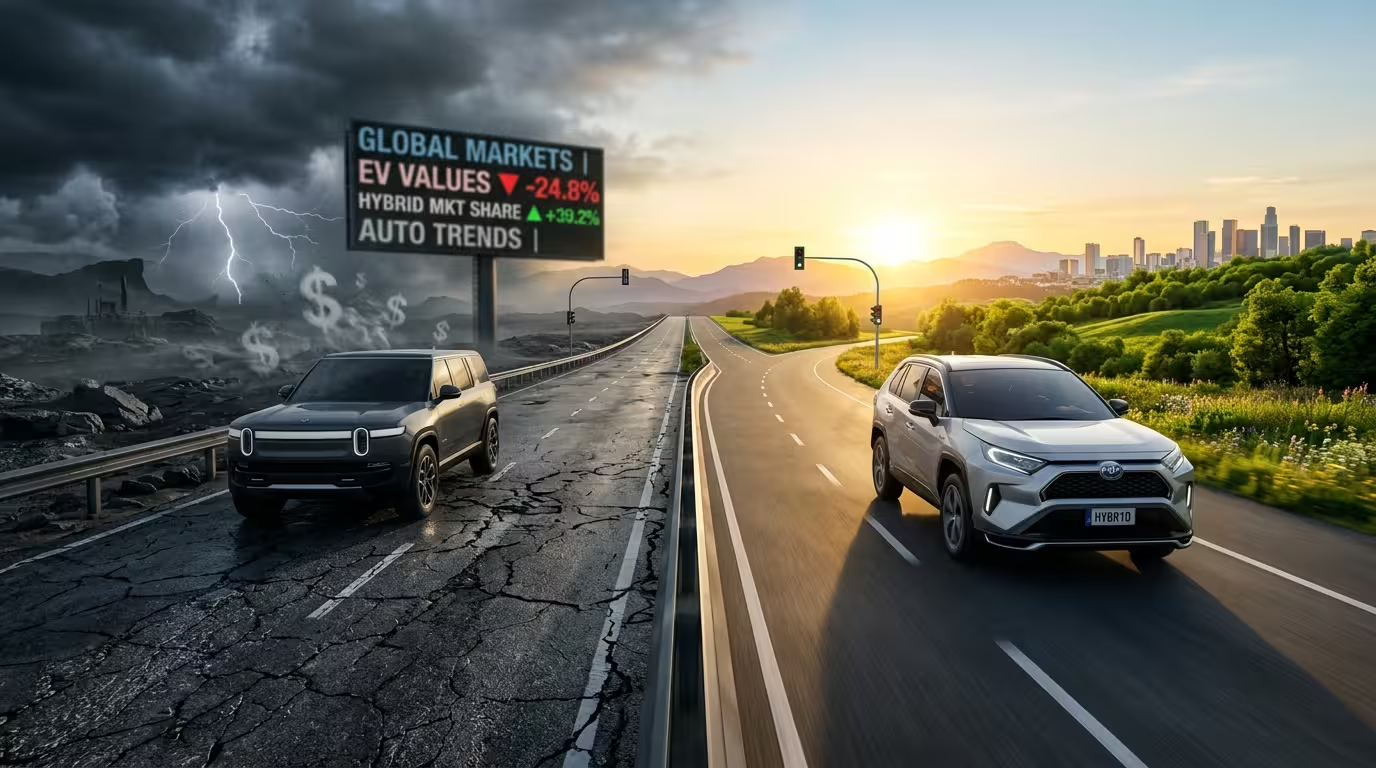
The auto industry just executed one of the sharpest strategic reversals in its history. After years of pouring billions into an all-electric future, the world's largest automakers are slamming the brakes. In the first half of 2026, electric vehicle demand has softened dramatically, while traditional hybrid sales have surged roughly 25% in the United States.
This isn't a minor market blip. It's a wholesale recalibration of what the next decade of personal transportation will look like. The story is being written in tens of billions of dollars of writedowns, frozen factory projects, and a single, unavoidable consumer truth: right now, the American driver wants electrification without compromise, and that means a hybrid under the hood.
If you're shopping for a new SUV this year, this shift changes everything pricing, availability, and the value equation between plugging in and just driving away.
Quick Facts: The State of the Industry in Mid-2026
- US hybrid sales: Up approximately 25% year-over-year, fueled by persistently high gas prices and the end of the federal EV tax credit.
- HEVs only growth segment: In the first quarter of 2026, traditional hybrids were the only powertrain category to register positive sales growth. Both battery electric vehicles (BEVs) and plug-in hybrids (PHEVs) declined.
- Industry-wide writedowns: Combined, Ford, General Motors, and Stellantis have recorded more than $53 billion in EV-related charges and restructuring costs in the past year. Honda posted its first-ever annual loss, driven by 2.5 trillion yen ($16 billion) in cumulative EV losses.
- Honda's frozen megaproject: An $11 billion Canadian EV and battery manufacturing hub is now suspended indefinitely.
- Mazda's delayed dreams: Mazda has pushed its first dedicated EV platform to 2029 and slashed its electrification investment by 40%, redirecting resources to hybrids.
- The lone bright spot: Hyundai's Ioniq 5, an electric crossover that no longer qualifies for federal tax credits, saw sales climb 14% in the first quarter.
Why Hybrids Are Winning Right Now
Three forces have converged to make the traditional hybrid the market's new sweetheart, and they're all rooted in the daily realities of American drivers.
Gas Prices
First, gas prices remain punishingly high. The geopolitical instability following the Iran conflict and the Strait of Hormuz disruption has kept fuel costs near record levels. For millions of households, the primary motivation for electrification is saving money at the pump, not making a statement. Hybrids deliver that savings immediately. You don't need a charger, and you don't need to alter your driving habits. That's a huge, quiet advantage.
With gas prices hitting record highs due to global instability, every MPG counts. Check how much you can save yearly with our Fuel Savings Calculator
Federal EV Tax Credit
Second, the federal $7,500 EV tax credit vanished in late 2025. That single policy change ripped away the demand lever that had artificially propped up the price parity between battery electric vehicles and their gasoline counterparts. When a new electric crossover suddenly became thousands more expensive overnight, many shoppers did the rational thing: they walked across the showroom and asked about the hybrid version. I've spoken with dealers who say this wasn't a dramatic moment just a slow, steady shift in which hybrid trims started outselling the pure EVs parked right next to them on the lot.
The Market Data
Third, the market data is unambiguous. According to NADA data, in April 2026 hybrids accounted for 14.5% of all new vehicles sold, up 9.2% year-over-year. Meanwhile, BEV market share collapsed to just 5.1%. In the first quarter, traditional hybrids were the only powertrain segment to register growth globally. The era of the "no-compromise EV" hasn't arrived yet, and buyers are voting with their wallets for the technology that fits their lives today.
The EV Bloodbath: Who's Retreating and Why
The balance sheets of the legacy automakers are telling the same story, and it's brutal. The industry bet the house on a transition timeline consumers refused to accept.
Below is a snapshot of the retreat.
| Automaker | Financial Impact | Strategic Move |
|---|---|---|
| Ford | $19.5 billion writedown | Cancelled the next-generation electric F-150 Lightning; the successor will be a hybrid. Converted a Kentucky battery plant project to an energy storage business. EV segment not expected to be profitable until 2029. |
| General Motors | $7.6 billion in EV restructuring charges | Discontinued the BrightDrop electric van, laid off more than 3,400 workers, and shuttered the Ingersoll, Ontario production line. An additional $6 billion in charges is flagged for 2026. |
| Stellantis | €22.2 billion (~$26.5 billion) charge | Stock fell nearly 25% in a single day. Suspended its 2026 dividend and admitted it overestimated the speed of the EV transition, which "distanced us from many car buyers' real-world needs." |
| Honda | 2.5 trillion yen ($16 billion) cumulative EV loss; first-ever annual loss | Indefinitely suspended an $11 billion Canadian EV hub. Cancelled three electric models planned for the US. |
| Mazda | ~$5 billion investment cut (a 40% reduction) | Delayed first dedicated EV platform to 2029. Lowered 2030 global EV sales target to just 15%. |
Why such a unified pullback?
Because legacy automakers discovered a hard truth about manufacturing economics. Building electric vehicles requires all-new platforms, expensive battery packs, and complex software. Those costs can't be shared with existing internal combustion engine lines. Hybrids, by contrast, are built on the same fully amortized assembly lines that have been pumping out profitable SUVs for years. For an industry staring at tariff uncertainty and softening consumer spending, pivoting to the profitable technology was a matter of survival.
What Dealers Are Telling Us Right Now
In conversations with sales managers across the Midwest and Southeast, a pattern has emerged. Hybrid SUVs like the Toyota RAV4 Hybrid and Honda CR-V Hybrid are moving faster than they can be stocked. Some lots have waiting lists of two to three weeks. Meanwhile, EV inventory is sitting longer, and manufacturers are quietly bumping up incentives.
One general manager of a multi-brand store told me his team has stopped proactively walking customers to the EV section unless they specifically ask. "It's not that the cars are bad," he said. "It's that the math doesn't work for the average family without the tax credit, and the hybrid does everything they want." That sentiment is echoed across the industry.
The Exception: Hyundai Ioniq 5 Sales Up 14%
Amid the gloom, the Hyundai Ioniq 5 posted a 14% sales increase in the first quarter of 2026, its strongest March ever. It did this without a penny of federal tax credit support.
The secret is aggressive, transparent pricing. Hyundai cut the 2026 Ioniq 5's sticker by an average of $9,155, bringing the base SE Standard Range model down to $35,000. Basically, the company baked the expired tax credit into the window sticker instead of asking the consumer to chase a rebate that no longer existed. That, combined with the Ioniq 5's genuinely compelling product standout design, a roomy cabin, and class-leading 800-volt fast-charging created a value proposition that made sense to buyers.
Hyundai's success proves that EVs don't have a demand problem as much as they have a value problem. When an automaker delivers a competitive product at a fair, transparent price, buyers still show up. But even Hyundai's numbers tell the fuller story: the brand's hybrid sales surged 55% in the same quarter, to more than 55,000 units. The electric Ioniq 5 is a bright spot, but hybrid volume still dwarfs it.
What This Means for 2026 SUV Buyers
This pivot isn't a distant financial story; it's a live buying guide.
If you're considering an electric vehicle, the market is tilting in your favor. Inventories are rising and automakers are discounting aggressively. The Ford Lightning and Honda Prologue have both seen significant price cuts in recent months. GM has paused some next-generation EV programs, which means current models are being offered with increasingly attractive incentives. An EV purchased today might be an extraordinary deal if you have reliable home charging and don't mind the slightly less convenient road trips. The cars themselves are often superb; it's the ecosystem and the pricing that have been the problem.
If you're leaning toward a hybrid, be ready to move fast. The same forces driving the 25% sales surge are tightening supplies. Popular models like the Toyota RAV4 Hybrid, Honda CR-V Hybrid, and Kia Sportage Hybrid are seeing increased wait times and, in some cases, dealer markups. The value proposition is powerful: 38 to 42 miles per gallon, no plug required, and a driving experience identical to a regular gasoline car. For the vast majority of American families, a hybrid SUV is the most practical and financially sound choice in 2026.
Original Analysis: 5-Year Ownership Costs, Hybrid vs. EV
We ran a quick numbers comparison for a typical compact crossover SUV over five years of ownership, assuming 15,000 miles driven annually and a mix of home and public charging for the EV. The results underscore why consumers are voting with their wallets right now.
| Cost Factor | Hybrid SUV (e.g., RAV4 Hybrid) | Electric SUV (e.g., Ioniq 5 RWD) |
|---|---|---|
| Average MSRP | $33,000 | $35,000 |
| Annual fuel/electricity cost | $1,300 (40 mpg, $3.50/gal) | $750 (home charging, $0.14/kWh) |
| Maintenance (5 years) | $2,100 | $1,500 |
| Federal tax credit | $0 | $0 (expired) |
| Total 5-year outlay | $40,500 | $41,250 |
Ownership costs are close, but financing matters. Use our Car Loan Calculator to see how a $33,000 RAV4 Hybrid compares to a $35,000 Ioniq 5 in monthly installments!
The Balanced View: EVs Aren't Dead, They're Resetting
It would be a mistake to read this moment as the death of the electric car. We're witnessing the painful, necessary end of the "EV-at-all-costs" era. The industry overbuilt for a demand curve propped up by government subsidies and early-adopter enthusiasm that has now cooled. The automakers that survive will be the ones balancing the dual reality of the 2020s hybrids pay the bills today, but long-term regulatory and climate pressures still point toward electrification.
Tesla's response to softening demand has been a series of sharp price cuts, acknowledging the new reality without abandoning the mission. Hyundai is proving a well-executed EV can grow even in a hostile market. And every major automaker is now pursuing a multi-pathway strategy, building hybrids, plug-in hybrids, and EVs simultaneously, and letting the customer decide. The great auto pivot of 2026 is not a U-turn back to gasoline; it's a pragmatic detour through the hybrid middle ground, and it will define the vehicles on our roads for the next decade.
Confused if you should go Hybrid or EV after the 2026 pivot? Take our What Car Suits Me? Quiz to find the perfect match for your driving habits.
Which Automakers Are Best Positioned for the Hybrid Boom?
Not all carmakers are equal in this new landscape. Toyota, Honda, Kia, and Hyundai have deep hybrid lineups, mature technology, and the manufacturing flexibility to pivot quickly. They stand to gain the most market share in the next 18 months. Ford and GM are scrambling to rebalance, and their recent announcements suggest they'll have competitive hybrid SUVs and trucks, but they're playing catch-up. Stellantis and Mazda face steeper climbs.
For buyers, this means the most reliable hybrid options right now come from the Asian brands. But don't sleep on Ford's upcoming hybrid F-150 if they get the pricing right, it could be a game changer.
Stay Ahead of the Shift
The auto industry is at a crossroads. Whether you're buying an EV or hybrid today, check our detailed reviews and comparisons before you decide. This story is still unfolding, and the vehicles you see on dealer lots next month might be discounted further or suddenly hard to find.
Disclaimer: This article is for informational and educational purposes only. It does not constitute financial or investment advice. Automaker financial figures are based on publicly available reports and news sources as of May 2026. Vehicle pricing, availability, and incentives are subject to change. Dealer insights are based on a small sample and may not reflect every region. Always consult a qualified professional before making purchasing decisions.Sources & Citations
Primary public references used for U.S. vehicle research on AutoTechSpot: