Volkswagen Quietly Ends ID.4 Production in the US After Massive Sales Collapse
Volkswagen is officially ending US production of the ID.4 in Chattanooga, shifting back to gas-powered Atlas SUVs after a brutal 95.6% sales crash in early 2026.
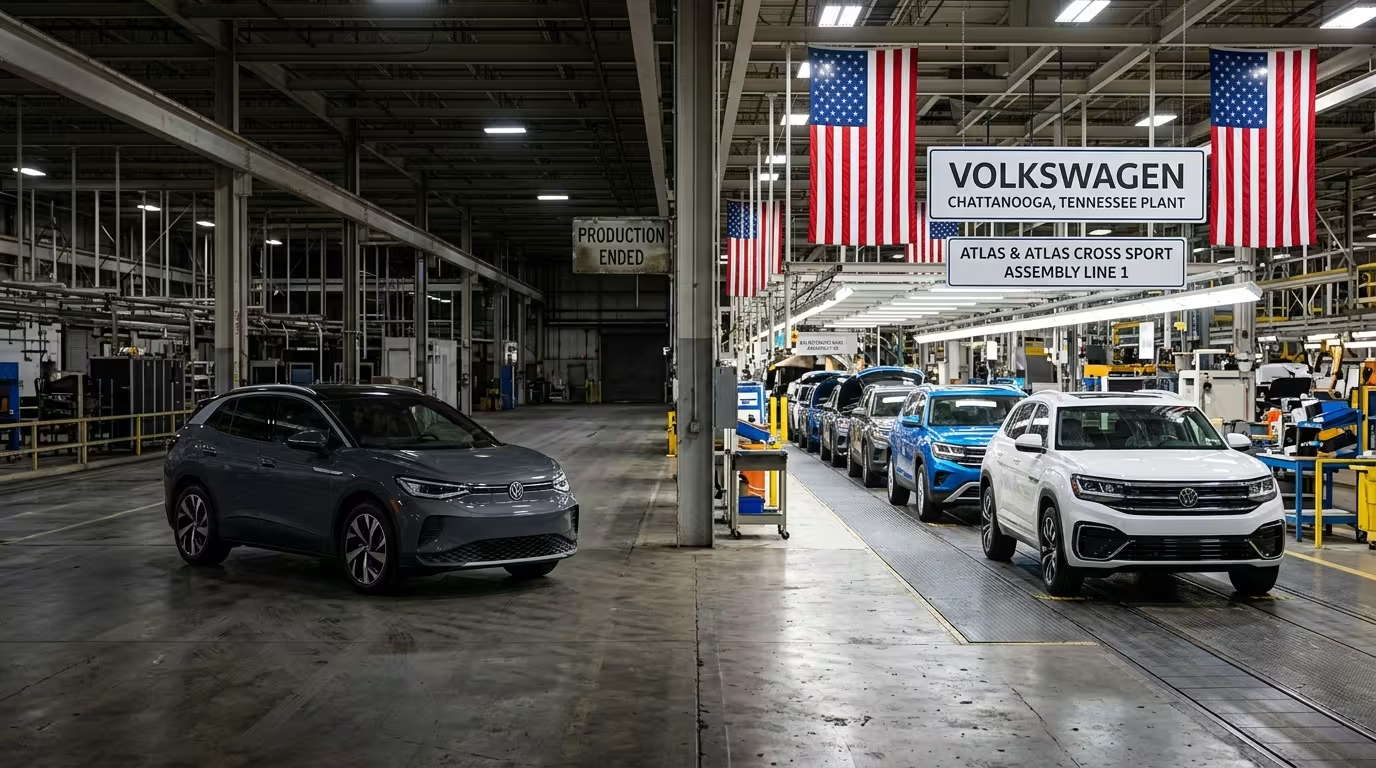
Volkswagen promised an electric future in America. Then the math changed. Here is what the Chattanooga shift really means for buyers, owners, and the EV market.
On April 9, 2026, Volkswagen announced it will end production of the ID.4 at its Chattanooga, Tennessee plant starting mid‑April 2026. The factory will not retool for another electric model. Instead, Volkswagen will build more gasoline‑powered Atlas and Atlas Cross Sport SUVs for the 2027 model year.
This is not a temporary adjustment. It is a strategic manufacturing decision driven by real‑world sales numbers. And it raises a clear question for American car buyers: is the ID.4 still a safe purchase?
“The EV market continues to challenge the industry, requiring measured decisions throughout the last few years to navigate this unpredictability. As part of the focus toward higher‑volume products that meet market demand, Volkswagen will no longer assemble the ID.4 in Chattanooga starting mid‑April 2026.”
Volkswagen official statement, April 9, 2026
Quick Facts: ID.4 Production Halt at a Glance
| Metric | Details |
|---|---|
| Production ends | Mid‑April 2026 |
| Plant location | Chattanooga, Tennessee |
| New production focus | 2027 Atlas / Atlas Cross Sport (gasoline) |
| Official reason | “Focus toward higher‑volume products that meet market demand” |
| US inventory status | 2026 ID.4 models remain available while supplies last |
| Expected inventory run | Into 2027 |
| Future ID.4 for North America | Confirmed, but no timeline or location provided |
| Global ID.4 production | Continues outside the US (Europe, rest of world) |
What Volkswagen Actually Said
Volkswagen’s announcement was precise. The company acknowledged that “the EV market continues to challenge the industry” and that “measured decisions” were required. The core sentence is worth reading twice:
“As part of the focus toward higher‑volume products that meet market demand, Volkswagen will no longer assemble the ID.4 in Chattanooga starting mid‑April 2026.”What does “higher‑volume products” mean in plain English? The Atlas and Atlas Cross Sport. In 2025, Volkswagen sold 71,044 Atlas units in the US, while the ID.4 managed only 22,373. The Atlas family (including Cross Sport) exceeded 100,000 sales, representing nearly a third of all Volkswagens sold in America.
Importantly, this is a US‑only manufacturing decision. ID.4 production continues in Europe, where the model remains popular and is currently receiving a facelift. Volkswagen also sells the ID.4 in China and other global markets. The Chattanooga halt reflects local market conditions not a global EV abandonment.
Talk vs Walk: A Closer Look
| What Volkswagen Said (Publicly) | What Volkswagen Did (Actually) |
|---|---|
| “The ID.4 is central to our US EV strategy.” | Ended US production after four years. |
| “We are committed to an all‑electric future.” | Shifted Chattanooga back to gasoline SUVs. |
| “The ID. Buzz is a halo product for the brand.” | Skipped the entire 2026 model year for ID. Buzz. |
| “EVs are the future of mobility.” | Prioritized higher‑volume gas models to protect plant profitability. |
Will the ID.4 Still Be Available in America
Yes! but only while inventory lasts.
Volkswagen has confirmed that 2026 model year ID.4 EVs will continue to be shipped to US dealers until existing stock is exhausted. The company expects that inventory to last into 2027. After that, the ID.4 will temporarily disappear from American showrooms because Volkswagen does not import ID.4s from other markets to fill the gap.
A Volkswagen spokesperson told InsideEVs that “a future version of ID.4 is currently planned for the North American market” but details on timing, specifications, and production location have not been announced.
What this means for buyers today
If you want a new ID.4, your window is roughly the next 6‑9 months. Once remaining 2026 units sell, there is no guaranteed supply until an unannounced future model arrives.
Why Volkswagen Made This Decision
The numbers are brutal.
In Q1 2026, Volkswagen sold only 338 ID.4 units in the US. That is a 95.6% year‑over‑year decline. The Q4 2025 picture was nearly as grim, with sales dropping 62% after the $7,500 federal EV tax credit expire.
Now look at the Atlas. With 71,044 units sold in 2025, the Atlas has ranked as Volkswagen’s second‑best‑selling vehicle in the US for three consecutive years. The Atlas twins combined exceeded 100,000 sales, making Atlas the most popular nameplate in VW’s US lineup.
From a profitability standpoint, the decision is logical. The Chattanooga plant employs nearly 4,000 workers. Shifting to a high‑volume, high‑margin gas SUV protects those jobs. Volkswagen Group of America President Kjell Gruner stated:
“This strategic shift underscores the company’s commitment to Chattanooga and its workforce as we position the plant for long‑term success.”The United Auto Workers, which unionized the Chattanooga plant in 2024, confirmed that job security protections in the newly ratified contract would prevent layoffs. UAW representative Kevin Gotinsky noted:
“All workers will remain employed while the company determines the path to the next model.”What This Means for Current and Future ID.4 Owners
Resale values
When a manufacturer stops producing a model in your market, used values often dip. However, EVs are already experiencing depreciation pressure. According to CarGurus data, the ID.4’s three‑year residual value had dropped to approximately 42% by late 2025. The production halt may accelerate that decline. If you lease an ID.4 today, expect lower residual support from VW Credit.
Service and parts
Volkswagen has confirmed that parts support for the ID.4 will continue through its existing dealer network. The Chattanooga plant’s closure does not affect service centers. However, if you own an ID.4, major battery or drivetrain repairs may face longer wait times if parts must come from Germany or Europe. No official guidance on that has been provided yet.
Lease vs buy
Given the uncertainty, leasing a remaining 2026 ID.4 is lower risk than buying. You avoid long‑term resale exposure. Volkswagen may also offer aggressive lease incentives to clear inventory worth checking with local dealers.
We spoke with a Volkswagen dealer in Tennessee (who requested anonymity due to corporate communication policies). Their take:
“Customers are asking if the ID.4 is being discontinued entirely. We have to explain it’s just US production ending. But honestly, that distinction gets lost. People hear ‘stopped making it’ and walk away.”How Volkswagen’s Move Compares to Rivals
| Automaker | Recent EV Manufacturing Action | Current US EV Strategy |
|---|---|---|
| Volkswagen | Ends ID.4 production in Chattanooga, shifts to Atlas gas SUVs | Paused US EV production; future ID.4 unconfirmed |
| General Motors | Paused next‑gen electric trucks (Silverado EV, Sierra EV, Escalade IQ) until 2030 or later (Reuters) | Scaling back near‑term EV investments |
| Ford | Cut F‑150 Lightning prices up to $4,000; brought back employee pricing for all EVs | Aggressive incentives to move inventory |
| Hyundai / Kia | Continuing Ioniq 5, Ioniq 6, EV6 production; no US plant pullback | Maintaining EV production and new model launches |
The ID. Buzz Is Also Affected
The ID.4 is not the only Volkswagen EV facing a US market adjustment. In December 2025, Volkswagen announced it would skip the entire 2026 model year for the ID. Buzz electric van in the US and Canada. The company will move directly from the 2025 model year to the 2027 model year, using existing inventory to cover the gap.
Volkswagen emphasized that the ID. Buzz is not canceled, but the decision to skip a full model year is unusual. It signals that the company is managing EV supply carefully rather than pushing volume into a soft market.
Industry Context the Broader EV Reality
Volkswagen is not alone. Across the industry, automakers have written down more than $55 billion in EV‑related adjustments since 2023. The common thread is clear: US consumers are not buying EVs at the volume automakers projected after the expiration of federal tax incentives.
GM’s pause on next‑gen electric trucks
In December 2025, General Motors told suppliers to pause development of next‑generation full‑size electric trucks and SUVs, including replacements for the Silverado EV, Sierra EV, Escalade IQ, and Hummer EV. Production is now not expected until 2030 or later.
Ford’s price cuts and incentives
Ford slashed F‑150 Lightning prices by up to $4,000 and reintroduced employee pricing across its EV lineup. The 2025 Lightning is available with up to $10,000 in combined incentives.
Hybrids are quietly winning
While pure EV demand softens, hybrid sales continue to grow. Toyota, Honda, and Ford have all reported double‑digit hybrid gains. For many buyers, a hybrid offers lower upfront cost and no charging anxiety.
What AutoTechSpot Readers Should Do Now
If you want a new ID.4
Act within the next 6‑9 months. Remaining 2026 inventory will be gone by early 2027. Consider leasing rather than buying to avoid resale risk. Check with multiple dealers for end‑of‑production incentives.
If you own an ID.4
Continue normal service. Parts support remains. But if you are considering selling or trading, do it sooner rather than later. Residual values may soften once inventory dries up and the “production ended” news fully sinks in.
If you want an Atlas
Good news. The 2027 Atlas and Atlas Cross Sport begin production in summer 2026, with dealership arrivals in fall 2026. The plant’s full focus on Atlas means better availability and potentially shorter wait times than in recent years.
If you are watching the EV market
Volkswagen’s move is a signal, not a funeral. The ID.4 continues globally. Hyundai and Kia are still building EVs in the US. But the era of aggressive, subsidy‑driven EV volume is over for now. Watch for 2027‑2028 model announcements to see which automakers double down and which pull back further.
Check your local Volkswagen dealer for remaining 2026 ID.4 inventory before it is gone. And follow AutoTechSpot for ongoing coverage of the shifting EV landscape because what automakers say and what they actually do are rarely the same thing.
Disclaimer: The information in this article is based on publicly available sources and official statements from Volkswagen Group of America as of April 2026. Production timelines, inventory availability, and future model plans are subject to change. Dealer comments are anonymized at the source’s request. AutoTechSpot recommends verifying current inventory and pricing with local dealerships before making purchasing decisions.Sources & Citations
Primary public references used for U.S. vehicle research on AutoTechSpot: