Rivian’s $46K SUV Could Be the Tesla Model Y Killer Everyone Has Been Waiting For
The 2027 Rivian R2 brings up to 345 miles of range, Tesla Supercharger access, and genuine SUV capability at a much lower price than the R1S. Can it finally challenge the Tesla Model Y?
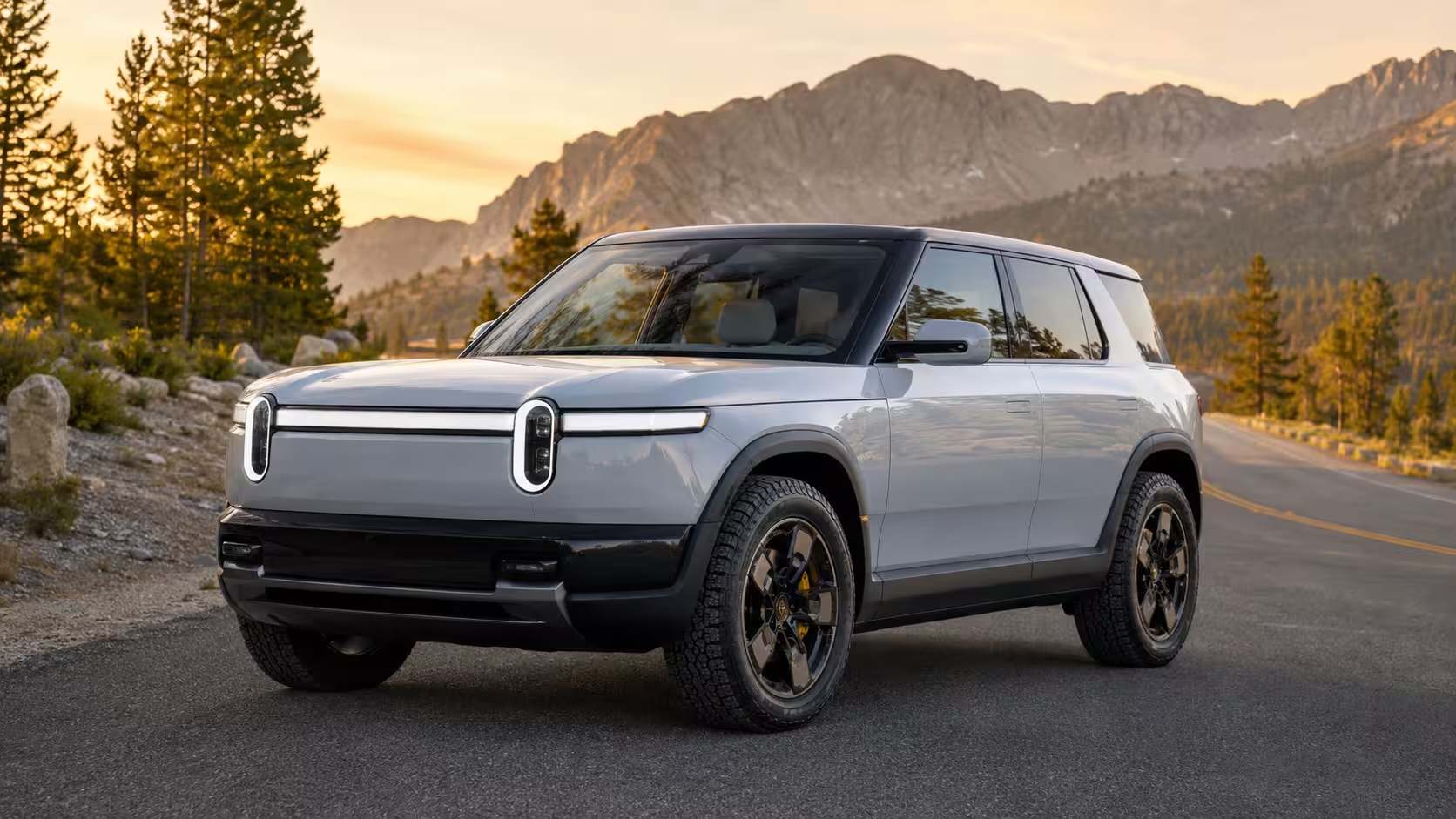
Quick Facts
The 2027 Rivian R2 is the smaller, more attainable Rivian SUV buyers have been waiting for. It keeps the brand’s adventure-ready character but moves into the heart of the electric compact SUV market.
| Category | 2027 Rivian R2 Details |
|---|---|
| Starting MSRP | $46,495 including destination for the eventual base Standard trim |
| Launch Price | $59,485 including destination for R2 Performance |
| Trims | Performance, Premium, Standard Long Range, Standard |
| Powertrain | Single-motor RWD or dual-motor AWD |
| Max Output | 656 hp and 609 lb-ft of torque |
| 0-60 mph | 3.6 seconds for R2 Performance |
| Max Range | 345 miles for Standard Long Range RWD |
| Performance Range | About 330 miles EPA-estimated |
| Charging | Native NACS port, 10-80% in under 30 minutes |
| Seating | 5 passengers |
| Total Storage | Up to 90.1 cu ft |
| Ground Clearance | Up to 9.6 inches |
Rivian’s Most Important SUV Yet
The 2027 Rivian R2 is Rivian’s most important product because it targets the part of the EV market where real volume lives. Instead of chasing only premium adventure buyers, Rivian is now aiming at households cross-shopping the Tesla Model Y, Ford Mustang Mach-E, Kia EV6, Hyundai Ioniq 5, and Volkswagen ID.4.
The R2 matters because it brings Rivian’s outdoor identity into a more usable size and price class. The R1S is impressive, but it is large and expensive. The R2 is smaller, easier to park, easier to justify financially, and still rugged enough to feel like a real Rivian.
This is a first look based on current manufacturer data, verified specifications, pricing information, and early prototype drive impressions. Production models and full independent testing will tell us more, especially around real-world range, charging curves, road noise, software reliability, and service experience.
Rivian R2 Pricing, Trim Levels, and Rollout Timeline
The R2’s pricing is attractive, but buyers need to understand the rollout. The least expensive version is not the one arriving first.
The launch model is the R2 Performance at $59,485 including destination. The eventual entry-level Standard trim is expected at $46,495 including destination, which makes the R2 far more accessible than the larger R1S.
| Trim | Powertrain | Output | Range | Starting Price | Availability |
|---|---|---|---|---|---|
| R2 Performance | Dual-motor AWD | 656 hp, 609 lb-ft | About 330 miles EPA-est. | $59,485 | Launch trim |
| R2 Premium | Dual-motor AWD | 450 hp, 537 lb-ft | About 330 miles EPA-est. | $55,485 | Late 2026 |
| R2 Standard Long Range | Single-motor RWD | 350 hp, 355 lb-ft | 345 miles est. | $49,985 | Early 2027 |
| R2 Standard | Single-motor RWD | 350 hp, 355 lb-ft | 275+ miles est. | $46,495 | Later 2027 |
The strongest buying case may be the Standard Long Range RWD. It keeps the R2 below the Performance trim’s price, delivers the headline 345 miles of range, and avoids the extra cost and energy demand of dual motors.
Compared with the larger R1S, the R2 should save many buyers tens of thousands of dollars while still offering Rivian design, software, NACS charging, and adventure credibility. If you are deciding between Rivian’s compact and full-size SUV options, read 2026-rivian-r1s-review
Before choosing a trim, calculate the full monthly cost, not just MSRP. Registration, insurance, home charger installation, electricity rates, and loan terms can change the ownership math quickly. Use our Car Loan Calculator to estimate your monthly payment.
Powertrain, Performance and Driving
The R2 may be Rivian’s smaller SUV, but it is not a budget-feeling EV. In Performance trim, it has the acceleration numbers to embarrass many gasoline sports sedans.
The R2 Performance uses a dual-motor AWD system producing 656 hp and 609 lb-ft of torque. Rivian claims 3.6 seconds from 0 to 60 mph, which puts it close to the Tesla Model Y Performance while giving buyers a more rugged SUV character.
Trim-by-Trim Power
The Premium trim should be the balanced AWD choice. Its 450 hp and 537 lb-ft output are still strong, and the 4.6-second 0-60 mph time is quick enough for daily driving, mountain roads, and effortless highway passing.
The Standard and Standard Long Range trims use a single-motor rear-wheel-drive setup with 350 hp and 355 lb-ft. That sounds modest next to the Performance version, but a 5.9-second 0-60 mph estimate is still brisk for a family SUV.
Handling and Ride Dynamics vs. R1S & Model Y
The more meaningful improvement may be how the R2 drives compared with the R1S. Early impressions suggest it feels more nimble and easier to place on the road, largely because it is smaller and lighter than Rivian’s three-row SUV.
Compared with the Tesla Model Y, the R2 is expected to be heavier by roughly 800 lbs in some configurations. That extra mass could affect tire wear, braking feel, and efficiency in aggressive driving, but Rivian appears to counter it with strong chassis tuning, a lower center of gravity, and selectable drive modes.
Off-Road Capability and All-Terrain Mode
For buyers who live near snow, gravel roads, campsites, forest roads, or rough rural driveways, the R2’s All-Terrain mode and 9.6 inches of ground clearance matter more than a tenth of a second in a 0-60 mph sprint. That is where Rivian’s brand identity becomes more than marketing.
Battery Range and Charging
The R2’s range story is strong, but the best number belongs to a specific version. The 345 miles figure applies to the Standard Long Range RWD trim, not the launch Performance model.
Performance and Premium trims are listed at about 330 miles EPA-estimated. That is still impressive for dual-motor electric SUVs with strong output, all-wheel drive, and higher ground clearance than most mainstream EV crossovers.
Efficiency vs. Standard EV Crossovers
The achievement is not just the range number. Rivian is targeting competitive efficiency while keeping real SUV proportions, usable cargo space, and nearly 10 inches of clearance. Most EV crossovers are optimized for pavement first. The R2 tries to balance daily efficiency with dirt-road confidence.
Against the Tesla Model Y Performance, the R2 Performance has a range advantage on paper. Tesla’s performance version is rated around 306 miles, while the R2 Performance is expected around 330 miles. Tesla remains quicker, but Rivian gives buyers more range and more ground clearance in a more adventure-focused package.
Charging Infrastructure and NACS Support
Charging may be the R2’s biggest everyday advantage. The native NACS port means owners can use compatible Tesla Superchargers without an adapter, reducing one of the biggest concerns for first-time EV buyers.
Rivian says the R2 can charge from 10% to 80% in under 30 minutes on a suitable DC fast charger. That sounds competitive, but road-trip usability will depend on the full charging curve, not just the peak rate. A vehicle that holds strong charging speeds longer is often better on long trips than one with a high short-lived peak.
Home Charging and Infrastructure Limits
Home charging will be the most convenient and cost-effective option for most owners. An 11.5-kW onboard charger should allow overnight charging for typical daily use, but apartment dwellers and street-parked buyers should confirm local charging access before ordering.
Try our Fuel Cost & Savings Calculator to estimate your annual savings compared to a gas SUV.
Interior Design and Technology
The R2 cabin is where Rivian feels meaningfully different from Tesla. It is still screen-heavy and modern, but the design aims for warmth, utility, and outdoor durability rather than pure minimalism.
The interior uses a large 15.6-inch center touchscreen, clean digital controls, practical storage, fold-flat seating, and sustainable materials such as recycled textiles and upcycled wood finishes on select trims. The layout should appeal to buyers who want an EV cabin that feels premium without becoming sterile.
Cargo Capacity
The extra glovebox storage is a smart touch. So is the total storage figure of up to 90.1 cu ft, which makes the R2 useful for families, road trips, camping gear, pets, sports equipment, and home-improvement runs.
Software Ecosystem
Rivian’s software is central to the experience. Over-the-air updates, navigation, drive modes, vehicle controls, charging tools, and Autonomy+ all live inside Rivian’s own ecosystem.
The downside is clear: Rivian does not currently offer Apple CarPlay or Android Auto. For some buyers, that will be a deal-breaker. Tesla owners are already used to this approach, but shoppers coming from Ford, Kia, Hyundai, or GM products may miss smartphone projection.
Climate Control and Winter Efficiency
The standard heat pump is a major ownership benefit in colder states. Heat pumps can reduce winter range loss compared with less efficient cabin heating systems, although real-world performance will still depend on temperature, speed, tires, elevation, and driving style.
Rivian R2 Safety, Driver Assistance, and Reliability
The R2 is being built as a modern EV platform with standard driver-assistance hardware and room for software improvements. That gives it a strong foundation, but final safety ratings still matter.
Rivian equips the R2 with advanced camera and radar-based systems designed to support collision avoidance, parking assistance, and highway driver assistance. Autonomy+ adds hands-free highway capability on compatible roads, but it should be treated as driver assistance, not self-driving.
Families should wait for official NHTSA and IIHS crash-test results before making final safety comparisons. Rivian’s larger vehicles have helped establish the brand’s credibility, but the R2 needs its own independent testing.
The bigger ownership question is software reliability. As with any connected EV, safety and driver-assistance systems can improve through updates, but buyers should also expect occasional learning curves as features evolve.
Rivian R2 vs. Tesla Model Y
The R2 is aimed straight at the Tesla Model Y, but it does not copy Tesla’s formula. Rivian is trying to win buyers who want EV efficiency without giving up SUV character.
Tesla still has major strengths: acceleration, software maturity, Supercharger familiarity, and a massive ownership base. Rivian counters with more ground clearance, a warmer cabin, rugged design, stronger adventure branding, and native NACS access.
| Model | Starting Price | Max Range | Horsepower | 0-60 mph | Key Advantage |
|---|---|---|---|---|---|
| Rivian R2 | $46,495 eventual base | 345 miles | Up to 656 hp | 3.6 seconds | Adventure capability, NACS, ground clearance |
| Tesla Model Y Performance | Mid-$50K to high-$50K range | About 306 miles | Not officially listed by Tesla | Around 3.3 seconds | Software, acceleration, Tesla ecosystem |
| Ford Mustang Mach-E | Varies by trim | Varies by battery and drivetrain | Varies by trim | Varies by trim | Sporty road manners, broad lineup |
| Kia EV6 | Varies by trim | Varies by battery and drivetrain | Varies by trim | Varies by trim | Fast charging, sharp design, strong value |
The Ford Mustang Mach-E remains a strong road-focused alternative, especially for buyers who prefer a sportier driving feel. The Kia EV6 is a value and charging-speed contender, but it does not offer the same upright SUV shape or adventure positioning.
The R2 is not a three-row family hauler. Buyers who need more seating, towing, or cargo flexibility should look at larger electric SUVs, including Rivian’s own R1S or premium options like Tesla’s Model X. For that market, see our review of the 2026 Tesla Model X.
Rivian R2 Pros and Cons
Early impressions suggest Rivian has built the R2 around the right priorities: size, price, range, charging access, and personality. The trade-offs are just as important.
Pros
- Strong value compared with the larger R1S
- Up to 656 hp in R2 Performance
- Quick 3.6 seconds 0-60 mph time
- Native NACS port for Tesla Supercharger access
- Up to 345 miles of estimated range on Standard Long Range RWD
- More manageable size than the R1S
- Up to 9.6 inches of ground clearance
- Premium-feeling cabin with useful storage
- Standard heat pump for cold-weather efficiency
- Better adventure credibility than most compact EV crossovers
Cons
- Cheapest trim does not arrive first
- Launch model starts at $59,485, not $46,495
- No Apple CarPlay or Android Auto
- Real-world range and charging still need independent testing
- Lower towing capacity than the R1S
- No third row
- Rivian’s service network is still smaller than Tesla’s
- Some advanced features may depend on subscriptions or future updates
Ownership Costs and What Buyers Should Know
The R2’s price is only part of the real ownership cost. Buyers should also consider insurance, charging, service access, maintenance, and tire replacement before choosing a trim.
Insurance will likely be higher on the R2 Performance because it has 656 hp, quick 3.6-second acceleration, advanced sensors, and expensive EV hardware. The Standard Long Range RWD trim should be cheaper to insure and may be the smarter choice for budget-focused buyers.
Charging costs will depend on where you plug in. Home charging is usually the cheapest option, while public DC fast charging is more convenient for road trips but often costs more. The native NACS port is a major advantage because it gives R2 owners easier access to compatible Tesla Superchargers.
Maintenance should be lower than a gas SUV because there are no oil changes, spark plugs, exhaust parts, or traditional transmission service. Main costs will likely include tires, cabin filters, brake fluid, wipers, alignments, and occasional service visits.
Tires could be a meaningful expense. The R2 is heavy, powerful, and available with large wheels or all-terrain tires, so tire wear may be higher than a normal compact SUV. For most buyers, the Standard Long Range RWD trim with home Level 2 charging should offer the best long-term value.
Who Should Buy the 2027 Rivian R2?
The Rivian R2 is worth waiting for if you want a compact electric SUV with genuine adventure capability, strong range, native Tesla Supercharger access, and a cabin that feels more distinctive than the Model Y’s minimalist interior.
The best all-around trim may be the Standard Long Range RWD. It offers the headline 345 miles of range, a lower expected price than AWD trims, and enough performance for most households.
The R2 Performance is the emotional choice. It brings 656 hp, AWD traction, 3.6 seconds to 60 mph, and the strongest version of Rivian’s adventure personality, but it also costs far more than the future base model.
Who Should Skip the 2027 Rivian R2?
Skip or delay the R2 if you need a third row, want the cheapest trim immediately, depend on Apple CarPlay or Android Auto, or live far from Rivian service support. Also consider waiting for full independent testing if real-world winter range, tire wear, and charging speed are top concerns.
For many buyers, though, the R2 may be the first Rivian that makes financial and practical sense. It is not simply a smaller R1S. It is Rivian’s best shot at turning its brand appeal into mainstream EV sales.
Not sure if the R2 is the right fit? Take our What Car Suits Me? Quiz.
Ready to join the Rivian adventure? Use our Car Loan Calculator to plan your budget, and then head over to Rivian's website to configure your R2. And if you're still weighing your options, our What Car Suits Me? Quiz can help point you toward the perfect electric SUV.
Disclamimer: The 2027 Rivian R2 is currently in its initial launch phase. The information in this article is based on data available as of June 2026, Specifications, pricing, and availability may change before full production begins.Sources & Citations
Primary public references used for U.S. vehicle research on AutoTechSpot: