AWD vs Winter Tires: Which Matters More for Ice and Slush?
All-wheel drive and winter tires solve different problems. This comparison breaks down which one matters more for ice, slush, packed snow, braking and cornering, and how to choose when your budget only stretches to one.
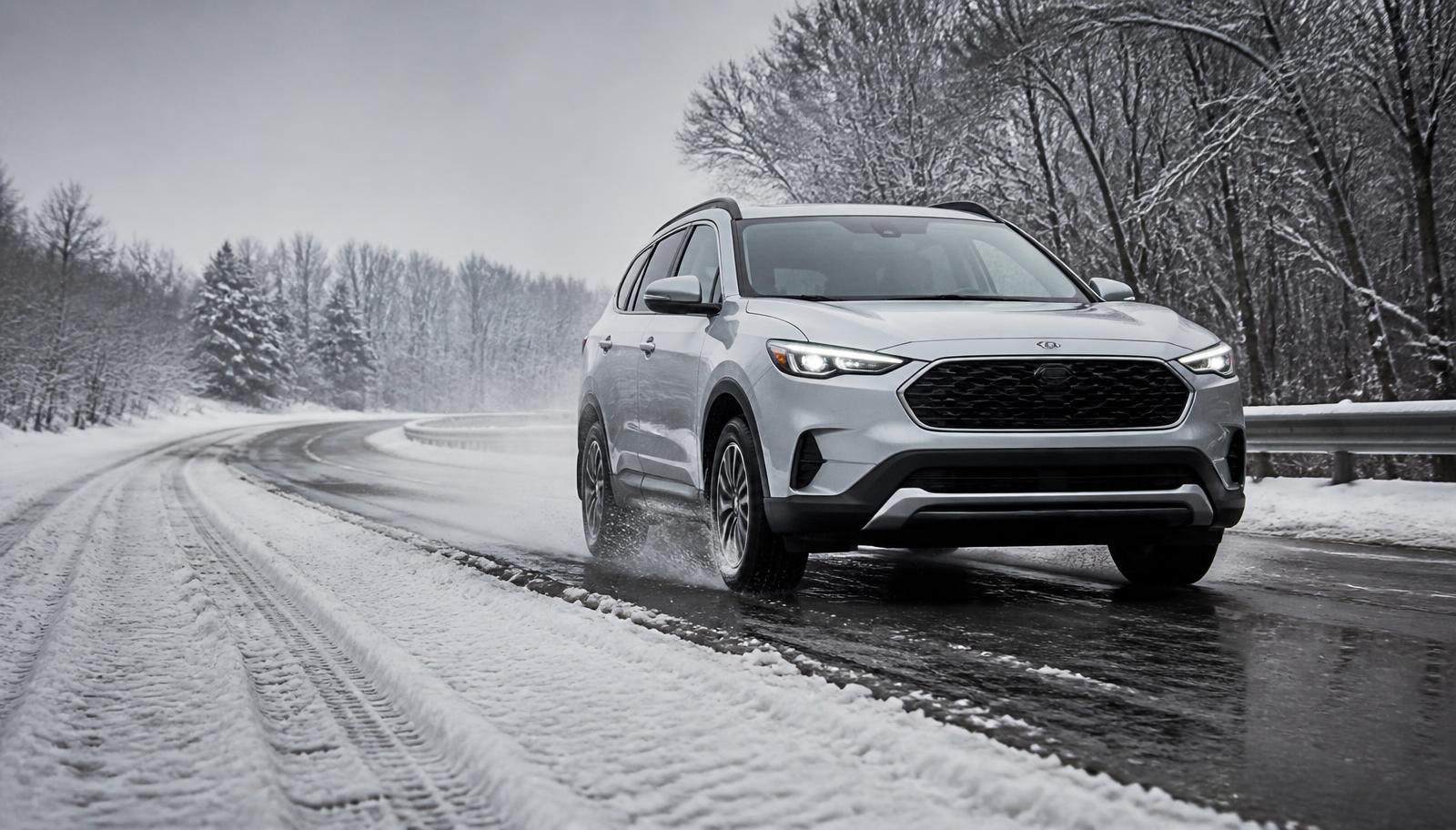
Every November, the same advice gets repeated in dealership showrooms and group chats: get all-wheel drive and you will be fine all winter. It sounds reasonable. It is also the reason plenty of AWD crossovers end up in ditches on the first icy morning of the season.
All-wheel drive and winter tires are not competing versions of the same upgrade. AWD changes how engine power reaches the road. Winter tires change how much grip exists at the road in the first place. One of those helps you get moving. The other decides how quickly you stop and whether the car goes where you point it.
This comparison separates those two jobs properly, condition by condition: acceleration, braking, cornering, ice, slush, packed snow and cold dry pavement. By the end you should know which upgrade solves your specific winter problem, and when the honest answer is that you need both.
Quick answer
AWD helps a vehicle put power down. Winter tires give the vehicle grip. Those are different problems.
- If you struggle to get moving, on snowy driveways, unplowed side streets or slick hills, AWD is the upgrade that addresses it.
- If you struggle to stop or steer, on ice, slush and cold pavement, tires are the upgrade that addresses it, and no drivetrain substitutes for them.
- If you drive in a genuinely severe winter climate, all-wheel drive with four winter tires is the strongest combination available to a normal road car.
- If your budget only covers one, and you already own a front-drive car, four winter tires usually buy you more usable winter safety than trading into an AWD vehicle on all-seasons.
What Does AWD Actually Do in Winter?
An all-wheel-drive system sends engine torque to both axles instead of one. Most modern car-based systems are automatic and reactive: they run mostly in front-wheel drive for efficiency, then send torque rearward when sensors detect wheel slip, a hard launch or a specific drive mode. Subaru's symmetrical setup and some performance systems drive all four wheels full time instead.
The practical effect is that engine power is spread across four contact patches rather than two. Each tire is asked to transmit less force, so each one is less likely to spin.
That matters in specific moments:
- Pulling away from a stop on packed snow or a slick intersection.
- Climbing a snowy hill, where weight shifts rearward and a front-drive car can run out of front traction partway up.
- Moving through deeper or unplowed snow, where four driven wheels keep momentum going instead of digging in.
- Getting out of a snowed-in parking spot or a plowed-in driveway apron.
| AWD helps with | AWD does not solve |
|---|---|
| Acceleration on slippery surfaces | A shortage of tire grip |
| Getting moving in snow from a stop | Poor cold-weather tire performance |
| Climbing slippery or unplowed hills | The physics of braking distance |
| Distributing engine torque across four wheels | The need for a safe following distance |
| Keeping momentum in deeper snow | Black ice on its own |
What Do Winter Tires Actually Do?
A winter tire is a different piece of engineering from a summer or all-season tire, not just a different tread pattern.
Compound. Winter tire rubber is formulated to stay flexible as temperatures drop. Michelin, Bridgestone and Continental all describe the same basic principle in their consumer material: standard all-season compounds stiffen in the cold, and a stiffer tire cannot conform to the microscopic texture of the road surface. Less conformity means less grip, before there is any snow on the ground at all. Tire makers commonly use roughly 45 degrees Fahrenheit, about 7 degrees Celsius, as the point where winter compounds start to pull ahead. Tread depth and pattern. Winter tread is deeper with wider grooves, which gives snow and slush somewhere to go instead of packing solid under the tire. Siping. The tread blocks are cut with hundreds of thin slits called sipes. These open under load and create thousands of biting edges that key into snow crystals and grip the rough texture of ice. This is the single largest reason winter tires outperform all-seasons on ice. Snow-on-snow traction. Packed snow in a tread groove grips other snow better than rubber does. Winter tread patterns are shaped to hold a small amount of snow deliberately.Those design choices translate into shorter stops, more cornering grip and more steering feedback in cold conditions. Independent comparison testing published by Tire Rack consistently shows dedicated winter tires stopping in less distance on snow and ice than all-season tires of equivalent quality, on the same vehicle.
This is not an argument that all-season tires are bad. Modern all-seasons are far more capable than the ones from a generation ago, and a good all-season handles cold rain and the occasional light snowfall respectably. The claim is narrower and more important: in sustained cold, on ice and on packed snow, an all-season tire and a winter tire are not interchangeable.
AWD vs Winter Tires: What Matters More?
Here is the honest condition-by-condition breakdown. The ratings below are qualitative editorial comparisons meant to show relative importance, not laboratory scores from a controlled test.
| Situation | AWD advantage | Winter tire advantage | What matters most |
|---|---|---|---|
| Starting from a stop on snow | High | High | Depends on your vehicle and the depth |
| Braking on packed snow | Limited | High | Winter tires |
| Braking on ice | Limited | High | Winter tires |
| Cornering on ice | Limited | High | Winter tires |
| Deep or unplowed snow | High | High | Both |
| Steep snowy hill | High | High | Both |
| Slush at speed | Moderate | High | Winter tires |
| Cold dry pavement | Little direct benefit | Moderate, compound dependent | Tires and conditions |
| Mixed winter commuting | Helpful | Very helpful | Both |
The one row where AWD genuinely leads is depth. If your problem is a foot of unplowed snow on a rural road, no tire alone fixes that. You need driven wheels at both ends and ground clearance, which is why our AWD vs FWD SUV comparison treats drivetrain as a terrain question rather than a safety question.
AWD vs Winter Tires on Ice
!Educational diagram comparing tire traction on ice, slush, packed snow and cold dry pavement
Ice is the condition that exposes the AWD myth most brutally.
The friction available between a tire and glare ice is a small fraction of what the same tire finds on dry asphalt. That number is set by the contact between rubber and ice. It does not change based on how many wheels the engine drives.
So on ice:
- Accelerating improves slightly with AWD, because each tire is asked for less torque. You may pull away from a stop more smoothly.
- Braking does not improve at all. Every wheel is braking anyway.
- Cornering does not improve either. Lateral grip is a tire property.
ABS and electronic stability control do not change the equation either. Both are mandatory on U.S. passenger vehicles and both are genuinely valuable, but they work by managing the grip that exists. ABS modulates brake pressure to keep a tire near its peak friction rather than locking. Stability control brakes individual wheels to correct a slide it has already detected. Neither can manufacture friction that the tire is not producing.
Which leaves tires and behavior. A winter compound with heavy siping is the only equipment change that meaningfully increases ice grip on a normal road car. Beyond that, the effective tools are the free ones: slow down, leave a much larger gap to the car ahead, brake and steer in separate smooth inputs rather than at the same time, and treat bridges, shaded curves and off-ramps as ice even when the rest of the road looks clear.
AWD vs Winter Tires in Slush
Slush behaves less like snow and more like standing water, and that changes what your tires are being asked to do.
At low speed, slush is mostly a traction nuisance. At highway speed it becomes a hydroplaning problem. The tire has to evacuate a heavy, semi-frozen mixture through its grooves fast enough to keep rubber on pavement. If it cannot, the contact patch floats and both steering and braking go light.
Tread volume is what solves that. Deep winter tread with wide circumferential grooves clears slush faster than a shallower all-season pattern, and a worn tire of any type clears it worst of all.
AWD's role in slush is real but limited. It helps you accelerate through a slushy patch and it can help stability slightly when torque is spread across both axles. It does nothing for the moment the front tires stop clearing slush and you lose steering.
Slush also deserves respect for being unpredictable. It refreezes as temperatures fall through the evening, so the same road that was merely wet at 4 p.m. can be ice at 8 p.m. Ridges of slush between lanes can tug at the steering when you change lanes. Spray from trucks kills visibility instantly, which makes wiper condition and washer fluid rated for freezing temperatures part of the traction conversation in practice.
What About AWD With All-Season Tires?
This is the setup most Americans actually own, and it deserves a fair hearing rather than a lecture.
AWD with good all-season tires is a perfectly sensible combination in a lot of the country. If your winter means cold rain, a few light snowfalls per year and roads that get plowed and salted quickly, it will serve you well. Modern all-season tires with the M+S marking handle light snow adequately, and all-weather tires (a distinct category, covered below) do noticeably better.
Where it falls short is severity and frequency. In a climate with repeated freeze-thaw cycles, regular ice and sustained temperatures below the point where all-season compounds harden, AWD with all-seasons gives you a vehicle that goes well and stops poorly. That combination is worse than it sounds, because the going part encourages speed.
| Driving environment | Recommended setup |
|---|---|
| Occasional light snow, mild winters | Modern all-season or all-weather tires are usually sufficient |
| Frequent snow through the season | Dedicated winter tires are worth the cost |
| Frequent ice or freeze-thaw cycles | Winter tires strongly worth considering |
| Deep or unplowed snow | AWD plus winter tires is the strongest setup |
| Mountain roads in winter | AWD plus winter tires, and check local chain rules |
| Mostly dry, cold winter climate | AWD matters less, tire compound still matters |
| Urban commuting on plowed, salted roads | Tires matter more than drivetrain |
What About FWD With Winter Tires?
If you already own a front-drive car, this is the most important section in the article.
Front-wheel drive is not the liability it is sometimes made out to be. The engine sits over the driven wheels, which loads the front tires and helps traction from a stop. Front-drive cars also tend toward understeer when grip runs out, which is more manageable for most drivers than a rear-end slide.
Put four winter tires on that car and you have a genuinely capable winter vehicle.
FWD with winter tires versus AWD with all-season tires:- Acceleration from a stop: the AWD car generally wins, especially in deeper snow or on a hill.
- Braking on snow and ice: the winter-tired car wins, and it is not close.
- Cornering grip: the winter-tired car wins.
- Deep, unplowed snow: the AWD car wins, and clearance may matter more than either.
- Cost: a set of winter tires is a fraction of the price difference to move into an AWD vehicle.
- Fuel economy: the front-drive car keeps its efficiency advantage, since AWD hardware adds weight and driveline drag. You can model the difference with our fuel cost calculator.
- Maintenance: fewer driveline components, and no requirement to replace all four tires at once when one is damaged.
AWD Plus Winter Tires: Is This the Best Combination?
Yes, with a caveat that matters.
The combination works because each element covers the other's weakness. AWD delivers torque to four contact patches. Winter tires make each of those contact patches grip harder. You get confident starts, meaningfully shorter cold-weather stops, better cornering, and the ability to keep moving through depth that would strand a front-drive car.
Vehicles that pair standard AWD with reasonable clearance make this easy to arrange. The Subaru Forester Hybrid and Subaru Crosstrek Hybrid are built around it, while mainstream crossovers like the Honda CR-V Hybrid, Hyundai Tucson Hybrid and Mazda CX-50 Hybrid offer AWD as an option worth checking against your actual conditions.
The caveat: this setup does not make icy roads safe. It shortens your stopping distance on ice compared with all-seasons. It does not make that distance short. Speed still determines whether you have enough room, visibility still determines whether you see the problem in time, and following distance is still the variable with the largest effect on your outcome. Equipment raises your margin. Driving decisions determine whether you spend that margin or keep it.
Do You Need Four Winter Tires?
Yes. Install winter tires as a complete matched set of four, from the same model and tread pattern.
Tire manufacturers and Tire Rack are consistent on this, and the reason is handling balance rather than pure traction. If you fit winter tires only to the front of a front-drive car, the front axle grips well and the rear axle does not. Lift off the throttle in a corner and the low-grip rear end can step out, producing an oversteer slide that is difficult to catch on a slick surface. Winter tires only on the rear creates the opposite problem: the car will not steer where you aim it while the rear happily follows.
Two winter tires is not a partial upgrade. It is a handling imbalance that behaves differently from the car you are used to driving, in exactly the conditions where predictability matters most.
Winter Tires vs All-Weather Tires vs All-Season Tires
The terminology here is genuinely confusing, and manufacturers are not always helpful about it.
| Tire type | Cold weather | Snow | Ice | Dry and warm roads | Best for |
|---|---|---|---|---|---|
| Winter (3PMSF, winter compound) | Excellent, stays flexible in deep cold | Excellent | Best available for a road car | Wears quickly, softer feel in warmth | Sustained cold, regular snow and ice |
| All-weather (3PMSF rated, year round) | Good | Good | Fair | Good | Moderate winters, drivers who will not swap tires seasonally |
| All-season (M+S only) | Fair, compound stiffens as it cools | Fair in light snow | Limited | Very good | Mild winters, mostly plowed and salted roads |
That is why all-weather tires occupy a real middle ground. They are a year-round tire that has passed the snow test, which suits drivers in moderate climates who do not want to store and swap a second set. They do not match a dedicated winter tire on ice, and they tend to wear faster than a comparable all-season.
Which Should You Choose: AWD or Winter Tires?
!Decision flowchart showing whether a driver should prioritize winter tires, AWD, or both
Lean toward AWD if:- You regularly deal with snow deeper than a few inches.
- Your street, driveway or workplace lot is plowed late or not at all.
- You live in hilly or mountainous terrain where getting moving uphill is the recurring problem.
- You are already shopping for a new vehicle and the AWD option is modestly priced.
- You tow, or you drive unpaved roads in winter.
- Ice and freeze-thaw cycles are your normal, not your exception.
- Your roads get plowed but stay slick and cold.
- Temperatures sit below roughly 45 degrees Fahrenheit for months at a time.
- You already own a front-drive or rear-drive vehicle and are not replacing it.
- You want the biggest safety improvement per dollar without changing cars.
- You live somewhere with a severe, long winter.
- Your winter driving mixes highway miles, ice and unplowed stretches.
- You cannot choose your travel days and need the car to work in whatever the morning brings.
How Much Do AWD and Winter Tires Cost?
Exact figures move constantly with tire sizes, brands and model-year pricing, so treat these as cost categories to budget for rather than quotes. Verify current numbers with a tire retailer and with the manufacturer's build-and-price tool for your specific vehicle.
All-wheel drive costs you:- A higher purchase price, since AWD is an option on most mainstream crossovers and sedans and standard on relatively few.
- Slightly lower EPA fuel economy, because of added weight and driveline drag. Hybrid systems using a rear electric motor tend to show a smaller penalty than mechanical setups.
- Additional driveline service items over the vehicle's life, depending on the system.
- A requirement on many AWD vehicles to replace tires in complete sets, since mismatched rolling diameters can stress the center differential or coupling. Check your owner's manual, because this is a real recurring cost.
- The tires themselves, four of them.
- Optionally a second set of wheels, usually steel, which raises the upfront cost but eliminates mounting and balancing fees twice a year.
- Seasonal swap labor if you do not have a second wheel set.
- Storage space for the off-season set, or a paid storage service at some shops.
If you are working out what any of this does to a monthly payment, run the numbers through our car loan calculator, or start from your budget with the how much car can I afford tool before you commit to the AWD trim.
Best Setup by Winter Driving Scenario
| Scenario | Best priority |
|---|---|
| Mostly rain with occasional light snow | Quality all-season or all-weather tires |
| Frequent snow, roads plowed regularly | Winter tires |
| Frequent ice and freeze-thaw cycles | Winter tires |
| Deep or unplowed snow | AWD plus winter tires |
| Mountain roads and steep grades | AWD plus winter tires |
| Urban winter commuting, short trips | Winter tires matter more than drivetrain |
| Budget-conscious, keeping current car | Four quality winter tires |
| Severe winter climate, no flexibility on travel days | AWD plus winter tires |
| Highway commuting in a cold, dry climate | Cold-capable tires, AWD optional |
Common AWD and Winter Tire Myths
"AWD means I do not need winter tires."
AWD distributes power. It does not increase the friction between rubber and road. On ice and packed snow, tire compound and siping determine your stopping and cornering ability regardless of drivetrain.
"AWD helps me stop faster."
Every car brakes with all four wheels. There is no drivetrain contribution to braking. Stopping distance comes down to tires, ABS behavior, road surface and speed.
"Winter tires are only worth it in deep snow."
The compound advantage starts as soon as temperatures fall, before any snow appears. Some of the biggest winter tire gains show up on cold dry and icy pavement, not in snowbanks.
"FWD is useless in snow."
Front-wheel drive puts engine weight over the driven wheels and tends toward predictable understeer. On winter tires it is a capable setup for plowed roads, and it beats an AWD vehicle on worn all-seasons where it counts.
"4WD automatically beats AWD."
They are built for different jobs. Part-time 4WD with a transfer case and low range is designed for low-speed traction in deep snow, mud and off-road terrain, and many systems should not be used on dry pavement. AWD is designed to operate continuously on road at speed. For an icy commute, AWD is usually the more useful of the two, and neither improves braking.
"All-season means all weather."
They are separate categories. All-weather tires carry the 3PMSF snow rating; most all-seasons carry only M+S, which is a tread description with no cold-weather test behind it.
"Stability control and ABS will save me."
Both are excellent at using available grip and neither can create it. They reduce the chance of a skid becoming a spin. They cannot shorten the physics of an icy stop.
"With AWD I can drive normally on ice."
This is the assumption that causes crashes. AWD accelerates confidently on ice, which disguises how little grip is available for stopping and turning. Speed and following distance still decide the outcome.
How to Prepare Your Car for Winter
Equipment choices matter, but so does basic readiness. Before the first freeze:
- Check tread depth on all four tires. Winter capability falls off sharply as tread wears, well before the legal minimum.
- Check tire pressure monthly. Pressure drops roughly 1 psi for every 10 degree Fahrenheit fall in temperature, so a tire set correctly in October is underinflated in January.
- Fit the right tires for your climate before the weather turns, not after the first storm when every shop is booked.
- Test the battery. Cold cranking demands more from a battery that was fine all summer, and most shops test them free.
- Fill washer fluid rated for freezing temperatures and carry a spare jug. Road salt spray is a visibility hazard.
- Replace worn wiper blades and lift them off the glass overnight if freezing rain is forecast.
- Clear all snow and ice from the whole vehicle, including the roof, lights and license plate, before driving. Roof snow slides onto your windshield under braking.
- Check that all exterior lights work, since winter driving happens in the dark far more often.
- Keep an emergency kit with a scraper, blanket, gloves, flashlight, jumper cables or a jump pack, and something to provide traction under a stuck wheel.
- Check the forecast and road conditions before long trips, and be willing to delay.
- Slow down early. Reduced speed and increased following distance are free, and they outperform every piece of equipment discussed above.
Final Verdict: AWD vs Winter Tires
There is no universal winner here, because AWD and winter tires are not solving the same problem.
For braking, cornering and cold-weather grip, which is where most winter incidents actually happen, tires are fundamental. No drivetrain layout compensates for a hardened all-season compound on ice.
For acceleration, hill starts and pushing through depth, AWD delivers a real, measurable advantage that tires alone cannot replicate.
If your winters are severe, AWD with four winter tires is the strongest combination available, and it is worth the cost. If you are choosing one, match the choice to your actual failure mode: winter tires if you cannot stop or steer, AWD if you cannot get moving.
And whichever setup you land on, neither one repeals physics. The most effective winter safety equipment on any vehicle is a driver who slows down early, leaves a large gap and accepts that some mornings are not worth the trip.
If you are shopping for the vehicle itself rather than the tires, our guide to the best cars for snow and winter driving in 2026 covers which models make winter easiest, and the Toyota RAV4 vs Honda CR-V and Kia Sportage Hybrid vs Hyundai Tucson Hybrid comparisons work through two of the most common AWD crossover decisions.
Sources and methodology
This article is an editorial synthesis of published manufacturer technical material, independent tire testing, and U.S. government winter driving guidance. AutoTechSpot did not conduct vehicle or tire testing for this comparison, and no braking distances, traction figures or prices are presented as original measurements. Qualitative comparisons in the tables reflect how each technology works mechanically, and should not be read as laboratory scores.
Sources & Citations
Primary public references used for U.S. vehicle research on AutoTechSpot: