Toyota RAV4 vs Honda CR-V: Which Compact SUV Wins in 2026?
The 2026 RAV4 goes hybrid-only while the CR-V keeps a gas option and the bigger cargo hold. Here is how America
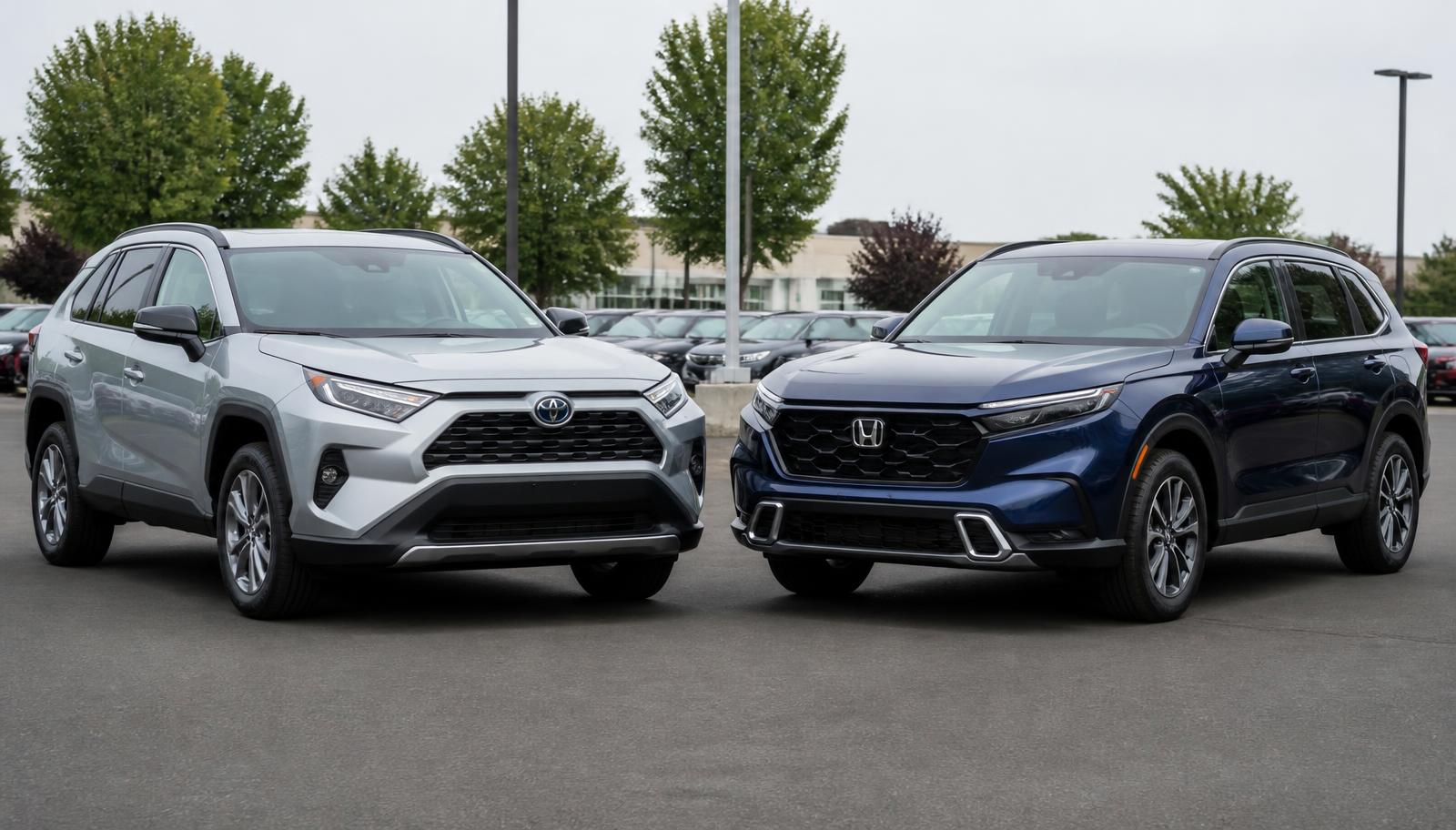
Two vehicles account for a remarkable share of every compact SUV sold in America: the Toyota RAV4 and the Honda CR-V. They sit next to each other on shopping lists, they trade the sales crown back and forth, and they are close enough on paper that plenty of buyers pick whichever dealer is nearer to home.
That was defensible in 2020. It is a mistake in 2026, because the two have moved in genuinely different directions.
The RAV4 arrived fully redesigned for 2026 with a hybrid-only lineup, a stiffer platform, a new interior, and a plug-in variant that behaves like a small electric car most weekdays. The CR-V held its shape: still one of the roomiest, quietest, most sensibly packaged SUVs in the class, still available as a plain gas model for buyers who want the lowest sticker.
So the honest framing is not "which is better." It is: do you want the more advanced powertrain, or the better-packaged box?
Quick verdict
| If this is you | Buy the | Reason |
|---|---|---|
| You drive 15,000+ miles a year | Toyota RAV4 | Hybrid-only lineup means every trim gets the efficient powertrain |
| You want the cheapest way into a new compact SUV | Honda CR-V | The gas 1.5-liter turbo trims undercut a hybrid-only lineup |
| You haul bulky cargo, bikes, or dogs | Honda CR-V | Class-leading cargo hold and a wide, low load floor |
| You have a home outlet and a short commute | Toyota RAV4 Plug-in | Roughly 50 electric miles covers most U.S. daily driving |
| Rear-seat passengers ride back there often | Honda CR-V | Airier rear bench, better outward visibility |
| You want the quieter, calmer highway car | Honda CR-V | Softer damping, less powertrain intrusion at cruise |
| You want the more modern cabin tech | Toyota RAV4 | New-generation infotainment and digital cluster |
| Snow, gravel, trailheads | Toyota RAV4 | More capable AWD hardware and rugged-leaning trims |
What actually changed for 2026
This is the part most comparisons skip, and it is the whole reason the two SUVs no longer overlap the way they used to.
The RAV4 is now hybrid-only. Toyota removed the naturally aspirated gas-only RAV4 from the U.S. lineup for the redesign. Every 2026 RAV4 pairs a four-cylinder with electric assist, in either standard hybrid or plug-in hybrid form. That lifts the floor of the range: even an entry trim gets the fuel economy that used to cost extra. The CR-V kept both doors open. Honda continues to offer a 1.5-liter turbocharged gas model alongside the two-motor hybrid. The gas trims are the price leaders in this matchup; the hybrid trims are where the CR-V gets genuinely good. Both are still five-seaters. Neither offers a third row. If you need one, our guide to the best cars for families with 3 kids in 2026 covers the three-row SUVs and minivans that actually work with car seats.For deeper single-vehicle detail, we have full write-ups on the 2026 Toyota RAV4 redesign and the 2026 Honda CR-V Hybrid.
Powertrains and performance
Toyota RAV4
The standard RAV4 hybrid pairs a 2.5-liter four with electric motors for a combined output in the mid-220-horsepower range, with all-wheel drive available through a rear-axle electric motor rather than a driveshaft. The plug-in hybrid is the quick one: combined output climbs past 300 horsepower, which makes it comfortably the fastest vehicle in this comparison.
In daily driving the RAV4's hybrid system is decisive. Off the line it uses electric torque, so the first 20 mph feels stronger than the numbers suggest. Under hard acceleration the engine gets vocal, which is the trade for the efficiency.
Honda CR-V
The gas CR-V uses a 1.5-liter turbo making around 190 horsepower through a CVT. It is smooth, adequate, and unremarkable, which is exactly what many buyers want.
The CR-V Hybrid uses Honda's two-motor system rated around 204 horsepower. Honda's approach runs the electric motor as the primary driver in most conditions and lets the engine act largely as a generator, which produces an unusually seamless, EV-like delivery around town. It is less punchy than the RAV4 hybrid but noticeably smoother.
Verdict: RAV4 for outright pace and for the plug-in option. CR-V Hybrid for refinement.Fuel economy and real running cost
Both hybrids land in the high-30s to low-40s mpg combined depending on drivetrain and trim, and the gas CR-V sits closer to the low 30s. Those are official-rating ballparks; treat trim-specific figures as confirmed only on the EPA window sticker of the exact vehicle you are buying.
What matters more than the headline number is how the gap plays out against your mileage. At 12,000 miles a year the difference between a 32-mpg gas CR-V and a 39-mpg hybrid is real but modest. At 25,000 miles a year, in a metro area with expensive gas, it is the difference between two very different annual budgets.
Run your own numbers before you decide: our Fuel Cost Calculator takes your annual mileage and local pump price and shows the actual dollar gap over a year. If you drive a lot, also read our best cars for long commutes guide, which explains why seat comfort and noise matter as much as mpg once you pass an hour a day behind the wheel.
The plug-in RAV4 changes the math entirely. With roughly 50 miles of electric range and a home outlet, a driver with a 20-mile round-trip commute may buy gas only for road trips. Without home charging, a plug-in is the wrong purchase, since you pay the upfront premium and drive it as a heavier ordinary hybrid.
Cargo space and packaging
This is the CR-V's clearest win and it is not close.
Honda's cargo hold measures roughly 39 cubic feet behind the rear seat and about 76 cubic feet with the seats folded, versus roughly 37 and 70 for the RAV4. On paper that is a modest gap. In practice it is bigger than the spec sheet implies, because the CR-V's opening is wider, its load floor is lower and flatter, and its rear seats fold closer to level.
The RAV4 answers with usability rather than volume: a squarer body, better sightlines out of the corners, and a taller stance that makes it easier to drop a bag on the rear seat without stooping.
Take your actual gear to the dealer. A folded stroller, a large dog crate, or a set of hockey bags will settle this argument in ten minutes, and no comparison article can do it for you.
Interior, tech, and rear seat
The redesigned RAV4 cabin is the newer-feeling of the two: larger central touchscreen on most trims, a fully digital instrument cluster, wireless Apple CarPlay and Android Auto, and a physical volume knob and climate controls that Toyota sensibly declined to bury in software.
The CR-V interior is older in design and better in ergonomics. The honeycomb mesh across the dash hides the air vents, the driving position is excellent, and the rear bench is the more comfortable place to spend two hours: more knee room, a flatter floor, and larger side glass that makes the space feel bigger than it measures.
If back-seat passengers are a regular part of your week, sit in the second row of both before you sign anything.
Ride, noise, and how they drive
The CR-V is the calmer car. Honda tuned it for absorption: it rounds off broken pavement, keeps wind and tire noise low at 70 mph, and asks very little of the driver. It is the better choice for a long, boring interstate.
The 2026 RAV4 is the more alert one. The redesign brought tighter body control and steering with more weight to it, and the rugged-leaning trims (Woodland and the sportier GR Sport-style setups) push that further with retuned suspension and grippier tires. The trade is a firmer ride on poor city surfaces.
AWD and winter capability
Both offer all-wheel drive. They are not equivalent.
The RAV4's available AWD, especially on the off-road-leaning trims, is the more capable system, with better torque distribution on loose surfaces and more ground clearance. It is the pick for gravel roads, unplowed streets, and trailhead parking lots.
The CR-V's AWD is a competent bad-weather system rather than an adventure system. It does what most buyers need, which is traction in snow and rain.
One caution worth repeating: AWD does not shorten your stopping distance on ice. Winter tires do more for cold-climate safety than a driven rear axle, and they cost far less. Our AWD vs FWD SUV guide walks through when the AWD premium is worth paying and when front-wheel drive plus proper tires is the smarter money.
Safety
Both SUVs ship standard driver-assistance suites: Toyota Safety Sense on the RAV4, Honda Sensing on the CR-V. Both include adaptive cruise, lane keeping, automatic emergency braking, and road-sign recognition.
Recent generations of both have earned strong ratings from IIHS and NHTSA, but crash-test scores are assigned per model year and per body style, and a redesign resets the clock. Look up the specific 2026 model and trim on the IIHS and NHTSA sites before you treat a rating as confirmed. We have linked both databases in the sources at the bottom of this article.
Price and value
Direct MSRP comparison is awkward here, and it is worth understanding why. The CR-V's entry price is lower because its entry trim is a gas model; the RAV4's entry price is higher because there is no gas trim to anchor the bottom of the range. Compare hybrid to hybrid and the gap narrows considerably.
Where the real money moves is the out-the-door number. Both models are in high demand, both sell close to sticker in many markets, and dealer add-ons vary enormously by region. Get written quotes from at least three dealers for each vehicle, and compare total financed cost rather than monthly payment. Our Car Loan Calculator shows how term length quietly changes what you actually pay, and How Much Car Can I Afford? works backward from your budget instead of from a sticker price.
Both hold resale value near the top of the segment, which softens the depreciation cost of buying either one new.
Reliability and ownership
Toyota's hybrid system is the most road-tested in the world, with two decades of high-mileage fleet data behind it. Honda's two-motor hybrid is newer but has built a solid record.
Practical notes for either purchase:
- Hybrid batteries in both carry long federal-minimum-plus warranty coverage; confirm the exact term in writing, since it varies by state.
- Hybrids are often gentler on brakes because regenerative braking does much of the slowing.
- Neither requires special maintenance beyond a normal service schedule.
- Both are cheap to insure relative to their price, though a plug-in premium is common.
Who should buy which
Buy the 2026 Toyota RAV4 if you drive high annual mileage, you want the newest cabin technology, you deal with real winter or unpaved roads, or you have home charging and can genuinely exploit the plug-in hybrid. Buy the 2026 Honda CR-V if you want the biggest cargo hold in the class, you carry rear-seat passengers regularly, you value a quiet and comfortable highway ride, or you want the lowest entry price in this matchup via a gas trim. Test drive both back to back on the same day if you are still torn. These two are close enough that the tie-breaker is almost always a feel thing, and feel does not survive a week of memory.Related reading
Cross-shopping beyond these two is smart. Our Kia Sportage Hybrid vs Hyundai Tucson Hybrid comparison covers the value-focused Korean alternatives, the hybrid vs gas SUV breakdown settles whether the hybrid premium pays back for your mileage, and sedan vs SUV is worth reading if you are not certain you need an SUV at all. Unsure where to start? The What Car Suits Me? quiz narrows the field in about two minutes.
Sources & Citations
Primary public references used for U.S. vehicle research on AutoTechSpot: